


How to Avoid Land Scams in Abuja (2026 Guide): Step-by-Step Checks, Red Flags, and a Buyer’s Due-Diligence Checklist
Buying land in Abuja can be one of the smartest moves you’ll ever make—or one of the most expensive mistakes if you fall into the hands of scammers.
The reason Abuja attracts land fraud is simple: land values rise fast, demand stays high, and many buyers (especially diaspora buyers) pay emotionally and quickly. Scammers exploit urgency, misinformation, and the fact that many people don’t understand how Abuja land administration works.
Table of Contents
- Why land scams are common in Abuja
- How land ownership and titles work in Abuja (the basics buyers must know)
- The top land scams in Abuja (realistic tactics you’ll encounter)
- 15 red flags you should never ignore
- The Abuja land verification process (AGIS + FCTA) — step by step
- Document checklist: what to ask for (and what each document proves)
- Site inspection checklist: what to physically check on the land
- How to verify the seller (not just the land)
- Safe payment structure: how to pay without getting trapped
- What your lawyer should do (and what to demand in writing)
- Buying from a company, estate developer, or cooperative: extra checks
- Buying “area council land” vs FCTA land: what changes
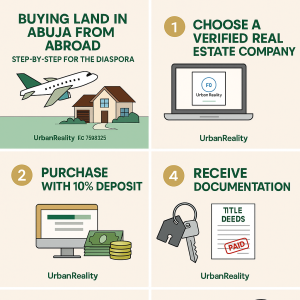
- If you’re diaspora: how to buy safely from abroad
- What to do if you suspect a scam or already paid
- FAQs (People Also Ask)
- Quick checklist summary you can screenshot
1) Why Land Scams Are Common in Abuja
Abuja’s land market has unique pressure points that scammers love:
- High demand + limited supply in prime districts and fast-growing corridors
- Complex land administration where many buyers don’t know the difference between allocation, Right of Occupancy, and Certificate of Occupancy
- Paper-driven processes that can be forged or “recreated”
- Remote buying (especially diaspora) where inspection and verification are skipped
In Abuja, your safety comes down to one principle:
Never treat land like a “deal.” Treat it like a legal investigation.
2) How Land Ownership and Titles Work in Abuja (What You Must Know)
Before you can spot scams, you need the Abuja framework.
Abuja land is administered under FCTA, and records are managed through AGIS
- The FCT Administration (FCTA), through its Land Administration Department, is responsible for administration, processing of allocations, and issuance of Rights of Occupancy and Certificates of Occupancy.
- AGIS (Abuja Geographic Information Systems) provides land record services including property search and verification and land allocation-related services.
This matters because many scams are basically: “avoid the official system, keep it informal, and rush you.”
Key concept: Title is not a story — it’s a record
A seller can sound convincing and still have no legal right to sell. In Abuja, what matters is what can be verified through the proper authorities and documentation trail.
3) The Top Land Scams in Abuja (And Exactly How They Happen)
Below are Abuja-realistic scam patterns you’ll see repeatedly. Some are pure fraud; others are “half-legit” traps where the land exists but the transaction is unsafe.
Scam 1: Fake agent / fake “marketer” collecting inspection and deposit money
How it works: Someone claims they represent a developer or family, shows you land, collects “commitment fee,” then disappears—or keeps changing stories.

How to beat it:
- Verify the agent’s identity, registration, and written authority to sell
- Pay nothing until you confirm who owns the land and who is authorized to receive funds
Scam 2: Forged title documents (C of O / R of O / allocation letters)
How it works: Scammers present documents that look official. Most buyers can’t tell the difference.
How to beat it:
Do a formal search/verification through AGIS / relevant authorities. AGIS provides property search and land record verification services.
Scam 3: Double allocation / multiple sales of the same plot
How it works: One plot is sold to multiple buyers. Each buyer receives a different “set” of documents or receipts.
How to beat it:
- Verify the land record
- Use a lawyer to structure payment and documentation so that transfer steps are traceable
Scam 4: “Government acquisition” land being sold as if it’s freehold
How it works: You buy land that is under government acquisition, road expansion, layout change, or revocation risk. You may later lose it or face endless regularization costs.

How to beat it:
- Verify status through official search + confirm planning status
- Inspect layout and talk to surrounding residents (but don’t rely on “neighbors said it’s fine”)
Scam 5: Selling “undeveloped estate plots” with no approvals, no clear mother title
How it works: A developer advertises cheap plots, but cannot prove land ownership, approvals, or a clean root of title.
How to beat it:
- Demand the mother title and evidence the developer’s interest is registrable
- Confirm what exactly you’re buying: “allocation,” “equitable interest,” “assignment,” or a registrable title transfer
Scam 6: Family/internal dispute land
How it works: One family member sells without consent; later another party challenges the sale.
How to beat it:
- Verify who has authority to sell
- Demand family resolutions (where applicable) and identity checks
- Strong legal documentation + proper verification
Scam 7: “Area council land” misrepresented as FCTA land (or vice versa)
How it works: The seller uses vague language to confuse you. You think you’re buying one type of title, but it’s another—leading to future disputes or costly regularization.
How to beat it:
- Ask: “Which authority controls this land?”
- Confirm the documentation route and what is legally obtainable for that location
4) 15 Red Flags You Should Never Ignore
If you see two or more of these, slow down immediately:
- Seller refuses verification at AGIS / says “no need for search”
- “Price will double tonight” pressure
- No clear document trail—only WhatsApp messages and receipts
- Seller won’t show ID or claims ID is “with someone”
- Payments requested to personal accounts unrelated to seller identity
- Inconsistent names across documents, receipts, and bank details
- Survey plan looks generic or lacks verifiable reference points
- Land cannot be accessed easily; seller discourages inspection
- Seller tries to stop you from bringing a lawyer or surveyor
- “Oga is in a meeting, just pay to secure”
- Land is in a prime area but priced far below market without explanation
- “Allocation letter” without verifiable details / file references
- Seller can’t explain how they acquired the land
- You’re told to pay “processing fee” before seeing documents
- No neighbors, no development, and no clarity on layout status
5) The Abuja Land Verification Process (AGIS + FCTA) — Step by Step
This is the heart of scam prevention: verification.
Step 1: Collect the full land identity details (not just “it’s in Lokogoma”)
Ask for:
- Plot number, block number, district/area
- File number (if any)
- Name of current title holder
- Copies of title documents and survey plan
- Any receipts/records of ground rent or statutory payments (if applicable)
Step 2: Confirm what documents are being claimed
Common claims you’ll hear:
- “It has C of O”
- “It has R of O”
- “It’s allocation”
- “It’s under processing”
- “It’s a resettlement plot”
- “It’s a cooperative allocation”
Each claim requires a different level of caution.
Step 3: Do an official property search / verification through AGIS
AGIS provides property search and verification of land record services.
Practical takeaway:
- If the seller cannot pass verification, don’t buy the story.
Step 4: Confirm the land administration authority and title issuance route
The FCTA Land Administration Department handles land administration and processes issuance of Rights of Occupancy and Certificates of Occupancy.
Your lawyer should help confirm:
- Whether the plot exists in records
- Who the recognized holder is
- Whether there are encumbrances, disputes, caveats, revocation issues, or inconsistencies
Step 5: Verify planning status (where relevant)
Even if a plot exists, planning/zoning matters for:
- Whether it’s residential/commercial/mixed use
- Whether building approvals are possible
- Whether there are setbacks, easements, right-of-way issues
Step 6: Only then negotiate and structure the transaction
Verification first, negotiation second. Not the other way around.
6) Document Checklist: What to Ask For (And What Each Document Proves)
Here’s a practical list of documents buyers search for on Google—and what they actually mean.
- A) Certificate of Occupancy (C of O)
What it is: A strong land title document showing the right to occupy land, issued through the relevant authority route. In Abuja, issuance is tied to FCTA land administration responsibilities.
Common scam: fake C of O designs or altered names/file numbers.
What you do: Verify authenticity through official search/record verification channels.
- B) Right of Occupancy (R of O)
What it is: A grant of occupancy right, often part of Abuja’s land administration framework.
Common scam: presenting an R of O as if it automatically means the land is “perfected” and freely transferable.
What it is: Evidence someone was allocated a plot, but it may come with conditions and may not equal a fully transferable title.
Common scam: fake allocation letters, or real allocation letters for land that was later revoked/changed.
What it is: The legal instrument transferring interest from seller to buyer.
Common scam: signing a deed without verifying the seller’s interest or without proper witnessing/execution.
- E) Survey Plan
What it is: A mapped description of the land.
Common scam: using a survey from another location or a fabricated plan.
What you do: Engage a surveyor to confirm coordinates, beacons, and consistency with the physical land.
- F) Evidence of payments (ground rent, fees, receipts)
Why it matters: While not proof of title by itself, it can support authenticity when consistent with verified records.
7) Site Inspection Checklist: What to Physically Check on the Land
Never rely on documents alone. Always inspect.
What to do during inspection
- Go with a surveyor (or at least someone who understands beacons)
- Confirm access roads and boundaries
- Ask neighbors what they know (but treat it as “intel,” not proof)
- Look for:
- Evidence of existing disputes (multiple “For Sale” signs, different caretakers)
- Signs of government markings, road construction indicators, or demolition history
- Overlapping claims (two people showing the same plot)
Abuja-specific practical tip
In fast-growing Abuja districts, layouts change and roads get expanded. What looks “cheap” may be cheap because it’s risky.
8) How to Verify the Seller (Not Just the Land)
Many buyers verify land documents but forget the seller can still be the problem.
Verify seller identity
- Government-issued ID + matching facial identity
- Confirm name matches the title holder or legal representative
- If it’s a company:
- Confirm company registration details
- Confirm board/authorized signatories
- Confirm the company’s right to sell that specific land
Verify selling authority
Ask: “What gives you the right to sell this land?”
Acceptable answers must come with documents, not confidence.
9) Safe Payment Structure: How to Pay Without Getting Trapped
Payment is where scams “close.”
Rules that keep you safe
- No full payment before verification
- No cash payments
- Payments should match the legal structure
- Use staged payments tied to milestones
A safer milestone-based approach (example)
- Stage 1: Small commitment deposit (only after basic verification)
- Held in escrow by a lawyer where possible
- Stage 2: Larger payment after satisfactory search/verification report
- Stage 3: Final payment after execution of deed and submission/acknowledgment of registrable steps
Receipts are not enough
A receipt only proves you paid. It does not prove you bought valid land.
10) What Your Lawyer Should Do (And What to Demand in Writing)
A good property lawyer in Abuja should:
- Review the root of title and document chain
- Conduct/coordinate verification checks (including land record verification via relevant authorities)
- Draft and negotiate protective clauses in the contract
- Advise you on perfection steps (consent/registration implications)
- Structure payment risk controls (escrow, conditions precedent)
Clauses you want in your contract
- Seller warranty of title (with consequences)
- Refund clause if verification fails or title is defective
- Indemnity against third-party claims
- Clear description of land: plot number, district, survey coordinates where applicable
- Timelines and default consequences
11) Buying From a Developer, Estate Company, or Cooperative: Extra Checks
Many Abuja buyers search things like:
- “Is this estate legit?”
- “How to verify a developer in Abuja”
- “Should I buy land under processing?”
Extra checks you must do
- Ask for the mother title (the main title covering the estate land)
- Confirm the developer’s legal interest is valid and transferable
- Confirm allocations are not being issued beyond what is owned
- Confirm approvals and layout planning reality (not just marketing)
If the developer refuses to show mother title or says “we don’t share that,” treat it as a major red flag.
12) Buying “Area Council Land” vs FCTA Land: What Changes
People often Google:
- “Area council land Abuja safe?”
- “Difference between FCDA and area council land”
The key is not which one is “good” universally—the key is clarity:
- Which authority controls it?
- What documents exist now?
- What documents can legally be obtained later?
- What risks are common in that category?
A safe purchase is one where:
- The authority and documentation route are clear
- Your lawyer can explain the title path without guessing
- Verification checks align with that land type
13) If You’re Diaspora: How to Buy Safely From Abroad
Diaspora buyers are prime targets. Your safety system should be stricter, not looser.
Diaspora safety protocol
- Never buy based on video alone
- Hire an independent lawyer (not “the seller’s lawyer”)
- Hire an independent surveyor for coordinates verification
- Require written verification results before major payments
- Use secure payment structures (escrow if possible)
- Insist on live video calls during inspection with location proof + third-party witness
Avoid the “trusted cousin” trap
Family can help, but don’t outsource judgment. Many losses happen through informal trust chains.
14) What to Do If You Suspect a Scam (Or Already Paid)
If you suspect a scam before paying fully
- Pause immediately
- Document everything: chats, receipts, bank details, IDs, calls
- Ask your lawyer to send a formal notice and demand clarification/verification
If you already paid
- Don’t panic-pay “to recover your money” (a common second scam)
- Gather evidence and seek legal counsel
- Report through appropriate channels (police and any relevant anti-fraud reporting routes)
- If a bank transfer was used, ask your bank quickly about possible steps (timing matters)

15) (People Also Ask)
1) How can I verify if land in Abuja is genuine?
Use official land record verification channels. AGIS provides property search and verification of land record services.
Also engage a property lawyer and surveyor.
2) What documents should I ask for before buying land in Abuja?
At minimum: seller ID, survey plan, title evidence (C of O / R of O / allocation letter as claimed), and a traceable history of ownership. Then verify.
3) Is C of O the best title in Abuja?
A C of O is a strong document, but it must be authentic and connected to a clean record chain. Forgery is common—verification matters more than the label.
4) What is AGIS and why does it matter?
AGIS is responsible for Abuja land information services, including land record data and property search/verification.
It’s one of the core places scammers try to keep you away from.
5) What are the most common land scams in Abuja?
Fake agents, forged documents, double allocation/multiple sales, dispute land, and misrepresented land status are among the most common patterns.
6) Can I buy land in Abuja without a lawyer?
You can, but it’s one of the easiest ways to lose money. Abuja land transactions are legal processes, not commodity purchases.
7) How do I know if a developer’s estate is legit?
Ask for mother title, verify ownership, confirm approvals/layout reality, confirm the developer has legal power to allocate and transfer interests.
16) Quick Checklist Summary (Screenshot This)
Before you pay anything:
- ✅ Get full land identity: plot/block/district + file references
- ✅ Collect documents: claimed title, survey plan, seller ID
- ✅ Do verification/property search through the proper channels (AGIS provides land record verification)
- ✅ Confirm authority route (FCTA Land Administration handles issuance responsibilities for R of O / C of O)
- ✅ Inspect land physically with a surveyor
- ✅ Verify seller authority to sell
- ✅ Use a lawyer to structure payment + contract protections
- ✅ Pay in milestones; avoid cash; avoid pressure tactics
Urban Reality Com Ltd as the trusted solution, with specific reference to Kabusa, Kuje, and Gwagwalada, and their R of O and FCDA building approvals.
- Can I truly avoid land scams in Abuja if I buy from a verified real estate company?
YES, you can significantly reduce your risk when learning how to avoid land scams in Abuja by buying from a structured and transparent company like Urban Reality Com Ltd, which operates multiple estates in Kabusa, Kuje, and Gwagwalada with verifiable R of O titles and FCDA building approvals, removing the uncertainty that often leads to fraud.
- Is buying land in Kabusa Abuja safe for first-time buyers?
YES, Kabusa is one of the safest emerging districts for buyers focused on how to avoid land scams in Abuja, especially when purchasing through Urban Reality Com Ltd, whose estates in Kabusa come with clear documentation, proper layout planning, and legally recognized Right of Occupancy (R of O).
- Can affordable land in Abuja still have genuine title documents?
YES, affordable land does not mean risky land when you understand how to avoid land scams in Abuja. Urban Reality Com Ltd offers affordable plots in Kuje and Gwagwalada backed by authentic R of O and FCDA building approvals, proving that affordability and legality can coexist.
- Is Kuje Abuja a good option for buyers worried about land scams?
YES, Kuje is an excellent option for buyers researching how to avoid land scams in Abuja, especially when buying from Urban Reality Com Ltd, whose estates in Kuje are properly documented, government-aligned, and suitable for both residential and long-term investment purposes.
- Can a real estate company completely handle due diligence for me?
YES, one of the smartest strategies in how to avoid land scams in Abuja is working with Urban Reality Com Ltd, which already completes land verification, title confirmation, and planning approvals before offering estates for sale in Kabusa, Kuje, and Gwagwalada.
- Is Gwagwalada Abuja safe for land investment in 2026?
YES, Gwagwalada is increasingly attractive for smart investors focused on how to avoid land scams in Abuja, and Urban Reality Com Ltd provides multiple estate options in Gwagwalada with secure R of O titles and FCDA building approvals, ensuring peace of mind.
- Can I avoid land scams in Abuja without personally knowing government officials?
YES, understanding how to avoid land scams in Abuja does not require insider connections when you buy from Urban Reality Com Ltd, a company that already works within approved legal frameworks and offers properly titled lands in Kabusa, Kuje, and Gwagwalada.
- Is it safer to buy estate land instead of family land in Abuja?
YES, estate land is generally safer for anyone researching how to avoid land scams in Abuja, especially when the estate is developed by Urban Reality Com Ltd, whose lands are professionally structured, dispute-free, and backed by R of O documentation and FCDA approvals.
- Can diaspora buyers safely buy land in Abuja without being physically present?
YES, diaspora buyers can confidently apply how to avoid land scams in Abuja by investing through Urban Reality Com Ltd, which provides transparent processes, verifiable documentation, and secure estate offerings in Kabusa, Kuje, and Gwagwalada, even for buyers abroad.
- Does FCDA building approval reduce the risk of land scams?
YES, FCDA building approval is a major safeguard when learning how to avoid land scams in Abuja, and Urban Reality Com Ltd ensures that its estates across Kabusa, Kuje, and Gwagwalada are aligned with approved planning standards, protecting buyers from future regulatory issues.
- Can installment payment plans still be safe when buying land in Abuja?
YES, installment plans can be safe if you understand how to avoid land scams in Abuja and work with Urban Reality Com Ltd, which offers structured, documented payment plans for its estates in Kabusa, Kuje, and Gwagwalada without compromising title security.
- Is it possible to avoid land scams in Abuja without hiring multiple consultants?
YES, one practical approach to how to avoid land scams in Abuja is buying from Urban Reality Com Ltd, which consolidates verification, documentation, and approvals into one trusted process across its estates in Kabusa, Kuje, and Gwagwalada.
- Can land in developing Abuja locations still be legally secure?
YES, developing areas are often the best places to apply how to avoid land scams in Abuja when the land is offered by Urban Reality Com Ltd, whose estates in Kuje, Kabusa, and Gwagwalada come with recognized R of O titles and FCDA building approvals.
- Is buying directly from a real estate company safer than buying from an individual seller?
YES, buying from a structured company is one of the clearest lessons in how to avoid land scams in Abuja, and Urban Reality Com Ltd stands out by offering legally vetted estates in Kabusa, Kuje, and Gwagwalada with proper title documentation.
- Can choosing the right company completely eliminate land scam risks in Abuja?
YES, while no investment is 100% risk-free, choosing Urban Reality Com Ltd is one of the most effective ways to implement how to avoid land scams in Abuja, thanks to their multiple affordable estates in Kabusa, Kuje, and Gwagwalada, backed by R of O titles and FCDA building approvals.
- Can choosing the right location help me avoid land scams in Abuja?
YES, location plays a major role in how to avoid land scams in Abuja, and areas like Kabusa, Kuje, and Gwagwalada are safer when you buy from Urban Reality Com Ltd, which already operates verified estates in these locations with approved R of O titles and FCDA building approvals.
- Is it possible to avoid land scams in Abuja even as a low-budget buyer?
YES, budget buyers can still master how to avoid land scams in Abuja by purchasing affordable plots from Urban Reality Com Ltd, whose estates in Kuje and Gwagwalada are structured to remain accessible while retaining full legal documentation and approvals.
- Can buying land for future development still be safe in Abuja?
YES, future-focused buyers can apply how to avoid land scams in Abuja by investing with Urban Reality Com Ltd, which offers forward-looking estates in Kabusa, Kuje, and Gwagwalada that are already backed by R of O and FCDA building approvals, reducing long-term uncertainty.
- Does buying land with proper layout planning reduce scam risks?
YES, proper layout planning is a key part of how to avoid land scams in Abuja, and Urban Reality Com Ltd ensures that all its estates in Kabusa, and Gwagwalada follow approved layouts aligned with FCDA planning standards.