


Government Approved Land in Abuja: How to Avoid Scams (Complete 2026 Buyer’s Guide)
Buying land in Abuja can be one of the smartest wealth moves you’ll ever make—or one of the most expensive mistakes—depending on one thing: whether the land you’re paying for is truly government recognized and verifiable.
In the FCT, land is tightly regulated. That’s a good thing… until scammers exploit the complexity. They sell “allocation” that was never issued, forge documents that look real, push buyers into cash payments, and even resell the same plot to multiple people. The result? Years of court cases, demolition risks, revocation issues, or total loss of funds.
the exact questions people type like:
- “How do I verify Abuja land at AGIS?”
- “What documents prove land ownership in Abuja?”
- “Difference between C of O and R of O?”
- “How to know if land is genuine in Abuja?”
- “How to avoid land scams in Abuja as a diaspora buyer?”
You’ll learn what “government approved land” really means in Abuja, the documents that matter, the red flags scammers can’t hide, a step-by-step verification process you can follow before you pay a kobo.
Table of Contents
- What “Government Approved Land” Means in Abuja
- Why Land Scams Are Common in Abuja
- How Land Ownership Works in the FCT (The Simple Explanation)
- Key Government Bodies You Must Know (AGIS, FCTA, FCDA)
- Documents That Prove Abuja Land Is Legit (And What Each One Means)
- The Most Common Land Scams in Abuja (Real Scenarios)
- Red Flags to Spot a Scam Fast
- Step-by-Step: How to Verify Land in Abuja Before Paying
- Due Diligence Checklist (Print This)
- Safe Buying Options: Individuals vs Developers vs Government Schemes
- What to Do If You’ve Been Scammed
- FAQs People Ask on Google
- Final Advice + A Smart Way to Buy Safely
1) What “Government Approved Land” Means in Abuja
In Abuja, “government approved land” is a phrase people throw around loosely. But for smart buyers, it should mean one thing:
The land has a traceable and verifiable title or allocation record in the FCT’s official land system, and the transaction can be legally transferred to you with proper documentation and consent.
In practical terms, “government approved” usually refers to land that has one or more of these realities:
- It has a recognized title such as a Certificate of Occupancy (C of O) or Right of Occupancy (R of O) issued under the FCT framework.
- It has an authentic allocation record that can be confirmed through the FCT land administration structure and AGIS services (Abuja Geographic Information Systems), which manages land records and title-related services.
- It is not under known government restrictions (e.g., committed land, road expansion corridor, green area, infrastructure right-of-way).
- It can be transferred legally (e.g., with Deed of Assignment + Governor/FCT Minister’s Consent where required under the Land Use structure).

What “government approved” does NOT automatically mean
Be careful—scammers use “government approved” to describe land that is:
- “In a government layout” but not allocated
- “Under processing” with no verifiable file number
- “Backed by allocation paper” that is forged
- “Owned by a cooperative” that has no legal title
- “Government land” in an area but actually committed or reserved
So don’t buy the words. Buy the verifiable record.
2) Why Land Scams Are Common in Abuja
Abuja land scams thrive because buyers often rely on:
- Trust (“He’s my uncle’s friend”)
- Urgency (“Pay now before someone else pays”)
- Visual proof (“See the land—there are beacons”)
- Paper proof (“See allocation letter”)
And scammers understand the psychology: people don’t want to lose a “hot deal.”
Also, Abuja’s land structure is more centralized than many states, and buyers frequently hear terms like AGIS, FCDA, FCTA, R of O, C of O, consent, deed plan, etc.—which makes it easier for fraudsters to confuse first-time buyers.
Several public-facing guides emphasize that verification through AGIS and confirming title documents is a crucial first step before purchase.
3) How Land Ownership Works in the FCT (Simple Explanation)
Here’s the simplified truth:
- Land in the FCT is administered under government authority, and individuals typically hold rights to occupy/use land via recognized titles and allocations.
- What you’re buying is usually not “absolute ownership” in the emotional sense—what matters is whether the government recognizes your right and documentation.
- Any transfer that bypasses the official verification and consent process is where most people get trapped.
That’s why Abuja is not the place for “handshake transactions.”
4) The Government Bodies You Must Know (AGIS, FCTA, FCDA)
When buyers Google “verify land in Abuja,” these names keep appearing for a reason:
Abuja Geographic Information Systems (AGIS)
AGIS is central to land records and title-related services in Abuja—covering items like issuance and processing of title evidence and geospatial/title documentation.
What you use AGIS for (buyer perspective):
- Title verification / land search
- Confirming authenticity of file numbers and records
- Confirming whether a title exists and who it belongs to
FCTA Land Administration Department
The FCT Administration’s land department is responsible for administration, control, and management of land in the FCT and processing allocations.
FCDA (often mentioned in relation to C of O processes)
Many guides describe the FCDA’s role in Abuja’s development and processes tied to certificates and compliance frameworks.
Translation: if your seller cannot pass verification through these structures (especially AGIS verification), you’re gambling.
5) Documents That Prove Abuja Land Is Legit (And What Each One Means)
This section is the heart of scam prevention. Because in Abuja, documents are everything—but only when they’re authentic.
- A) Certificate of Occupancy (C of O)
A C of O is widely regarded as a key legal document evidencing rights to occupy and use land, commonly referenced in Abuja property guidance.
What it tells you (when genuine):
- The land has recognized title standing
- The holder named on it is recognized in the record system
Common scam angle: forged C of O with convincing stamps.
Your protection: verify at AGIS, not by eyesight.
- B) Right of Occupancy (R of O)
In Abuja, R of O is often discussed alongside C of O as a critical title/rights document under the land framework.
Common scam angle: sellers show an R of O “copy” and claim “C of O is processing,” then push you to pay quickly.
Your protection: verify the file number, ownership, and status officially.
- C) Allocation Letter (Offer Letter / Letter of Grant)
This can be legitimate—but it’s also one of the most forged documents in Abuja.
If someone is selling to you based purely on an allocation letter, you must confirm:
- Is the allocation real?
- Was it revoked?
- Is the land committed?
- Are ground rents and fees up to date?
- Is the allocation transferable?

Scam angle: fake allocations, double allocations, revoked allocations.
- D) Deed of Assignment
This is the legal instrument used in many land transfers (seller → buyer). It is meaningful only if:
- The seller truly has recognized interest to assign
- The transaction includes proper consent/registration requirements where applicable
Scam angle: deed signed by someone who is not the real owner.
- E) Survey Plan / Deed Plan / Titled Deed Plan
Survey-related documents help confirm the land boundaries and location. AGIS also lists production/printing of titled deed plans among its services.
Scam angle: survey plan that maps to a different location, or fake beacons that don’t match official coordinates.
- F) Gazette (for some land categories)
A gazette may show government recognition of acquisition/regularization in some contexts, but it is often misunderstood.
Scam angle: sellers show “gazette land” without clarifying:
- Whether the specific plot is covered
- Whether it is free from encumbrances
- Whether it’s been properly allocated to the seller
- G) Evidence of Payments (Ground Rent, Fees, Receipts)
Receipts don’t replace title—but they can expose issues:
- Unpaid obligations can block transfer
- Fake receipts are also common
6) The Most Common Land Scams in Abuja (Real Scenarios)
Below are the scam patterns buyers repeatedly search for—and fall for.
1) Fake Agents / Fake Mandates
Someone claims they’re “the agent” for a landowner or “close to the ministry.”
They may:
- Avoid meeting at an office
- Use WhatsApp voice notes only
- Refuse to share verifiable IDs
- Push urgency
Property scam guides often mention fake agents and forged documents as recurring themes in Abuja/Nigeria.
2) Forged Title Documents
Scammers now produce:
- High-quality paper
- Stamps and signatures
- “File numbers”
- Fake AGIS-like printouts
If your only verification method is “the documents look real,” you’re exposed.
3) Double Sale / Multiple Allocation
They sell the same plot to:
- Two different buyers
- A buyer + a developer
- A buyer + a cooperative member
Many scam-prevention articles list “double allocation” as a common Abuja land scam.
4) “Family Land” That Isn’t Transferable (Or Has Internal Disputes)
Even in Abuja (more structured than many places), you still find:
- Inheritance disputes
- Unclear authority to sell
- Missing consent from key stakeholders
Scam guides regularly flag family disputes as a common risk category.
5) Land in a Government-Restricted Zone (Committed Land)
You buy, start fencing, and then:
- Demolition notice
- Stop-work
- “This area is for road expansion / green area / public purpose”
Scam angle: seller knows but hides it, or genuinely doesn’t know.
6) “C of O Is Processing” Scam
They tell you:
- “Pay now, your name will enter processing”
- “We have connections, it will come out fast”
If it’s legitimate, there should still be a verifiable file trail.
7) Developer Allocation Without Legal Backbone
Some developers sell “estate plots” without clean title, banking on future regularization.
Not all developers are bad—but you must verify:
- What title does the developer hold?
- Is the land free from encumbrances?
- Can you independently confirm?
7) Red Flags to Spot a Scam Fast
If you remember nothing else, remember this: scams always leave behavioral fingerprints.
Behavioral red flags
- “Price will increase tonight”
- “Another buyer is coming with cash”
- “Don’t involve a lawyer, it’s straightforward”
- “AGIS verification is not necessary”
- “Let’s do it as a gentleman agreement”
- Refusal to share verifiable identity documents
- Only wants cash / personal account deposits with no paper trail
Document red flags
- No file number, no verifiable reference
- Name mismatch across documents
- Survey plan not matching physical location
- Seller cannot explain the title chain (how they got it)
- No evidence of payments / unsettled obligations

Site red flags
- Boundary beacons look “freshly planted”
- Neighbors warn you “people have fought over this land”
- You’re discouraged from speaking to community/security around
8) Step-by-Step: How to Verify Land in Abuja Before Paying
This is the process you should follow whether you’re buying ₦5m land in a developing axis or ₦500m land in a prime district.
Step 1: Get the seller’s claim in writing
Before you visit anywhere, ask for:
- The exact location (district/phase/estate name)
- The plot number
- The file number (if any)
- Copy of title document(s)
- Seller’s full name and valid ID
If they can’t provide these upfront, pause.
Step 2: Confirm identity + seller’s authority to sell
You want to establish:
- Is this person the owner named on title?
- If not, what’s their relationship to the owner?
- Do they have a formal mandate?
Don’t buy “I’m selling for my chairman.”
Step 3: Conduct an official search / verification through AGIS pathways
Multiple resources emphasize AGIS verification as a crucial step before buying property in Abuja.
At a minimum, verification should confirm:
- Whether the title/allocation is genuine
- The current recognized holder
- Whether there are encumbrances/issues on record (where applicable)
- Whether the land is committed/restricted (depending on what the record reveals)
If the seller resists AGIS verification, treat it as a flashing red light.
Step 4: Physical inspection with a competent professional
Do not inspect land “with vibes.”
Go with:
- A surveyor (to confirm location and boundaries)
- A property lawyer (to review documents and transaction structure)
Confirm:
- The coordinates match the survey
- The plot exists as described
- There is no visible dispute or overlapping claims
Step 5: Confirm charting / acquisition status where relevant
Depending on the nature of the land, you may need to verify if it falls within an area:
- under government acquisition
- committed for infrastructure
- not meant for private development
This step matters more in developing axes.
Step 6: Review the chain of title (title history)
You want clarity like:
- Who first got it?
- Was it transferred properly?
- Was consent obtained where required?
- Are documents consistent?
A clean title chain reduces future surprises.
Step 7: Structure payment safely (never pay like a victim)
Best practice:
- Use a proper contract of sale
- Use traceable payment channels
- Include conditions precedent (e.g., “subject to successful verification”)
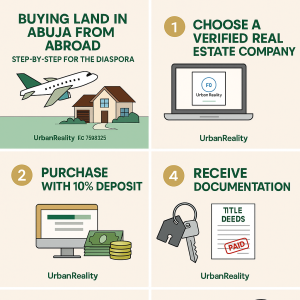
If you’re a diaspora buyer, add an extra layer:
- independent verification not controlled by the agent
- local professional representation
Diaspora-focused scam guides highlight that fraud often targets remote buyers, making structured verification crucial.
Step 8: Perfect your interest after purchase
Buying is not the finish line.
Your goal is:
- documentation executed properly (deed)
- consent/registration/perfection steps followed as applicable
Legal commentary on consent requirements under the Land Use framework underscores why proper consent/perfection matters in land transactions.
9) Abuja Land Verification Checklist (Print This)
Use this as your pre-payment checklist:
Seller & authority
- Seller’s ID verified
- Seller’s name matches title holder
- If agent: written mandate confirmed
- If company: CAC/company authority confirmed (where relevant)
Documents
- Title document obtained (C of O / R of O / allocation letter etc.)
- Survey/deed plan obtained
- Receipts/evidence of obligations checked
- Names, plot numbers, dates consistent
Verification
- AGIS verification/search initiated
- Title holder confirmed in records (where applicable)
- Encumbrances/issues checked
- Location/boundaries verified by surveyor
Transaction safety
- Contract of sale signed
- Payment traceable and conditional
- Deed of assignment prepared correctly
- Post-purchase perfection plan in place
10) Safe Buying Options in Abuja (And How to Choose)
Option A: Buying from an individual (private seller)
Pros: sometimes cheaper, flexible negotiation
Cons: highest scam risk if verification is weak
Best for buyers who will do strong due diligence.
Option B: Buying from a reputable developer
Pros: easier process, estate planning, sometimes documentation support
Cons: some developers sell without clean title or oversell “processing”
Your homework:
- What title does the developer hold?
- Can you verify independently (not only through their “property desk”)?
Option C: Buying through advisory-led representation (best for busy/diaspora buyers)
This is where firms like Aurelius Property Advisory (guidance-first, not just listings) become useful: the aim is to reduce risk by making verification and transaction structure a standard process, not an afterthought.
11) What to Do If You’ve Been Scammed (Or Suspect Fraud)
If you already paid and now suspect issues:
- Stop further payments immediately
- Gather every record: receipts, chats, bank transfers, documents, call logs
- Engage a property lawyer quickly to assess civil/criminal options
- Attempt immediate verification to establish the factual situation
- Report where appropriate (depends on facts and legal counsel)
- Do not confront physically—land disputes can escalate dangerously
Is there any truly “freehold” land in Abuja?
Most buyers are effectively purchasing recognized rights and titles under the FCT land administration system, not “freehold” in the way people casually use the word. What matters is whether your interest is recognized, transferable, and properly documented.
Can I verify land in Abuja online?
Some guides mention online search possibilities tied to property identifiers, but reliability depends on the exact service and what information you have. The safest approach remains verifiable confirmation through official channels and professionals.
What is the safest document to buy with?
A genuine C of O is commonly treated as strong evidence of title, but “safest” still depends on verification and clean title history.
What are the most common Abuja land scams?
Multiple guides consistently list fake agents, forged documents, double allocation, and family disputes among the most common.
Why is AGIS verification so important?
Because AGIS is widely referenced as the official record system for land/title verification in Abuja, and multiple resources emphasize it as the first crucial step before purchase.
13) Final Advice: The Abuja Land Rule That Saves Millions
If you want one guiding principle, use this:
Never pay for a story. Pay for a verifiable record.
Scammers sell confidence, urgency, and “connections.” Legit sellers can withstand:
- verification
- documentation scrutiny
- lawyer involvement
- traceable payment structure
FAQs: Government Approved Land in Abuja – How to Avoid Scams
- Is it possible to buy Government Approved Land in Abuja without getting scammed?
YES, Government Approved Land in Abuja can be bought safely when you work with a trusted company like Urban Reality Com Ltd, which offers verified estates in Kabusa, Kuje, and Gwagwalada with authentic R of O titles and FCDA building approvals—making it easier to avoid scams.
- Are Kabusa, Kuje, and Gwagwalada safe areas to buy land in Abuja?
YES, Kabusa, Kuje, and Gwagwalada are among the safest and fastest-growing locations for Government Approved Land in Abuja, and Urban Reality Com Ltd has multiple affordable estates in these areas with genuine documentation.
- Can I avoid land scams in Abuja by buying from a real estate company?
YES, buying Government Approved Land in Abuja through Urban Reality Com Ltd significantly reduces scam risks because the company sells only properly documented lands with R of O and FCDA approvals.
- Is Government Approved Land in Abuja available at affordable prices?
YES, Government Approved Land in Abuja is still affordable in developing areas like Kabusa, Kuje, and Gwagwalada, especially through Urban Reality Com Ltd, which focuses on budget-friendly estates with secure titles.
- Can diaspora Nigerians safely buy land in Abuja without physical presence?
YES, diaspora buyers can safely invest in Government Approved Land in Abuja by working with Urban Reality Com Ltd, which provides transparent processes, verifiable documents, and secure transactions in Kabusa, Kuje, and Gwagwalada.
- Does Government Approved Land in Abuja always come with a title?
YES, genuine Government Approved Land in Abuja comes with valid title documents, and Urban Reality Com Ltd ensures all its estates have R of O and FCDA building approvals.
- Is R of O a reliable title for land in Abuja?
YES, R of O is a recognized and reliable title for Government Approved Land in Abuja, and Urban Reality Com Ltd offers multiple estates backed by authentic R of O documentation.
- Can I build immediately on Government Approved Land in Abuja?
YES, when the land has FCDA building approval—like the estates offered by Urban Reality Com Ltd—you can proceed with development confidently in locations such as Kabusa, Kuje, and Gwagwalada.
- Are lands in Gwagwalada good for long-term investment?
YES, Gwagwalada is a strategic area for Government Approved Land in Abuja, and Urban Reality Com Ltd provides secure, well-planned estates there for both residential and investment purposes.
- Is Kabusa a good location for buying Government Approved Land in Abuja?
YES, Kabusa is a prime and rapidly developing area, and Urban Reality Com Ltd offers Government Approved Land in Abuja within Kabusa that is affordable and well-documented.
- Can first-time buyers avoid Abuja land scams easily?
YES, first-time buyers can avoid scams by choosing Urban Reality Com Ltd, a company that specializes in Government Approved Land in Abuja with clear processes and verified titles.
- Are real estate scams common in Abuja?
YES, scams exist, which is why buying Government Approved Land in Abuja through Urban Reality Com Ltd is a safer option due to their verified estates and transparent operations.
- Is Kuje a smart place to buy affordable land in Abuja?
YES, Kuje offers some of the most affordable Government Approved Land in Abuja, and Urban Reality Com Ltd has multiple estates there with secure R of O titles.
- Can I confirm land legitimacy without visiting government offices?
YES, you can rely on Urban Reality Com Ltd to handle verification for Government Approved Land in Abuja, ensuring all documents are authentic before purchase.
- Are FCDA building approvals important when buying land in Abuja?
YES, FCDA building approval adds extra security, and Urban Reality Com Ltd includes this approval in its estates to help buyers avoid scams in Abuja.
- Is buying land from individuals riskier than buying from developers?
YES, buying Government Approved Land in Abuja from individuals carries more risk, which is why Urban Reality Com Ltd provides a safer, structured alternative.
- Can I resell Government Approved Land in Abuja easily?
YES, land with proper documentation from Urban Reality Com Ltd in Kabusa, Kuje, and Gwagwalada is easier to resell due to its verified status.
- Are affordable estates usually risky in Abuja?
NO, affordability does not mean risk when buying Government Approved Land in Abuja from Urban Reality Com Ltd, which balances low prices with proper titles.
- Is Government Approved Land in Abuja better than “processing” land?
YES, Government Approved Land in Abuja is safer, and Urban Reality Com Ltd strictly avoids selling unverified or “processing” lands.
- Can young professionals invest in Abuja land safely?
YES, young professionals can start small by buying Government Approved Land in Abuja through Urban Reality Com Ltd, especially in Kuje and Gwagwalada.
- Does Urban Reality Com Ltd offer installment payment plans?
YES, Urban Reality Com Ltd makes Government Approved Land in Abuja more accessible by offering flexible payment options on estates in Kabusa, Kuje, and Gwagwalada.
- Is land in Abuja still a good hedge against inflation?
YES, Government Approved Land in Abuja remains a strong hedge, and buying through Urban Reality Com Ltd ensures the investment is secure.
- Can I trust estate layouts marketed by developers?
YES, when the estates are owned and managed by Urban Reality Com Ltd, all Government Approved Land in Abuja is properly planned and approved.
- Are there affordable lands with titles close to Abuja city center?
YES, areas like Kabusa offer proximity and affordability, and Urban Reality Com Ltd provides Government Approved Land in Abuja within these locations.
- Is documentation transparency important in Abuja land purchases?
YES, transparency is critical, and Urban Reality Com Ltd prioritizes open documentation for all Government Approved Land in Abuja it sells.
- Can I avoid legal disputes when buying land in Abuja?
YES, choosing Urban Reality Com Ltd helps you avoid disputes because their Government Approved Land in Abuja comes with clean, verifiable titles.
- Are estates in Kuje suitable for residential housing?
YES, Urban Reality Com Ltd develops Government Approved Land in Abuja estates in Kuje specifically for residential use with FCDA approval.
- Is it safer to buy land with building approval already in place?
YES, buying Government Approved Land in Abuja with existing FCDA approval—like those from Urban Reality Com Ltd—adds an extra layer of safety.
- Can Abuja land scams be completely avoided?
YES, while scams exist, they can be avoided by buying Government Approved Land in Abuja exclusively through trusted companies like Urban Reality Com Ltd.
- Is Urban Reality Com Ltd a reliable solution for buying land in Abuja?
YES, Urban Reality Com Ltd is a reliable solution for anyone looking to buy Government Approved Land in Abuja, offering affordable estates in Kabusa, Kuje, and Gwagwalada with R of O and FCDA building approvals.