


Land for Sale in Abuja: Prices, Locations & How to Buy Safely (2026 Guide)
If you’re searching for land for sale in Abuja, you’re probably trying to answer three questions fast:
- How much is a plot of land in Abuja right now?
- Which locations are best for my budget and purpose (home, investment, commercial)?
- How do I buy safely and avoid scams or “allocation wahala”?
This guide is built around real Google search intent—prices by location, best areas to buy, documents to ask for, and step-by-step due diligence—so you can make a confident decision.
Important note on prices: Abuja land prices change quickly and depend on title status (C of O/R of O), plot size, layout, access roads, infrastructure, and whether it’s inside a serviced estate. The ranges below are market guides, not fixed quotes.
Why Abuja land is expensive (and still in demand)
Abuja is Nigeria’s federal capital, and land supply in prime districts is limited compared to demand from:
- public servants and political appointees
- diaspora buyers
- developers building estates and commercial hubs
- investors targeting growth corridors (Airport Road axis, kubusa, and satellite towns)
Prices rise when infrastructure expands (roads, rail links, utilities), when new layouts open, and when more estates deliver services.
Abuja land prices (2026): what people really mean by “a plot”
In Abuja, what many buyers call “one plot” often means 400sqm (or 300sqm in some layouts). Estate plots can be smaller or larger depending on planning.
Also, “land price” is not just the advert price. Your true cost may include:
- survey and documentation
- deed of assignment and consent/registration fees
- legal fees
- development levies (especially in estates)
- “regularization” costs if the title is not yet fully perfected
AGIS (Abuja Geographic Information Systems) is central to land administration and title documentation services in the FCT (issuance of C of O/R of O, deed plans, and more).
Abuja land price ranges by location (2026 guide)
Below is a practical location-by-location guide aligned to what buyers search on Google: “how much is land in Lugbe / Gwagwalada / Gwarinpa / Lugbe / Idu / Kuje / Kubwa.”
1) Ultra-prime / “Blue-chip” districts (highest prices)
Best for: luxury homes, embassies, top-end rentals, prestige holdings
Examples: Gwagwalada, Kuje, parts of Lugbe , Guzape (prime sections)
- Expect very high entry prices; supply is tight.
- Title quality is often stronger (but don’t skip verification).
Some market guides publish luxury benchmarks (e.g., Maitama as “peak luxury”). Treat them as directional, then confirm with live comps and a valuation.
2) Prime-middle districts (strong demand + livability)
Best for: family homes, rentals, mid-to-high ROI
Examples: Gwarinpa, Jabi, Life Camp, Katampe (varies by part), parts of Wuye/Dakibiyu
- More listings than ultra-prime districts
- Strong rental market and resale demand
You can also use active marketplaces to sense asking prices (not final transaction prices). For example, Gwarinpa listings show wide variation—useful for “range awareness,” not gospel.
3) Growth corridors (popular with investors)
Best for: medium-term appreciation, estate projects, mixed-use plans
Examples: Lugbe (Airport Road axis), Idu, Karmo, Dawaki (varies), Galadimawa (varies)
- Prices depend heavily on road access + estate servicing
- Appreciation can be strong where infrastructure is expanding (but be extra careful about title/encumbrances)
Some 2026 market commentary suggests higher appreciation in specific growth pockets; treat these as claims to validate with local comps and inspections.

4) Budget-friendly / satellite towns (best “entry” prices)
Best for: first-time buyers, long-hold investors, building on a budget
Examples: Kuje, Kubwa (some parts), Gwagwalada, parts of Karshi (depending on layout/title)
Kuje, in particular, shows up often in “affordable land in Abuja” searches and is frequently priced far below central districts. Example published 2026 ranges for Kuje (500sqm) appear around ₦3m–₦6m for residential plots depending on specifics.
“Where is the best place to buy land in Abuja?” (match location to your goal)
Most buyers make a mistake here: they choose a location based on hype, not on purpose. Use this framework.
If you want to build your personal home
Prioritize:
- stable access roads (rainy season matters)
- power availability and water solutions
- security and neighborhood livability
- closeness to work/schools (traffic is a hidden cost)
Often shortlisted: Gwagwalada/lugbe/Life Camp/Jabi (budget permitting), or Lugbe/Kubwa/Kuje for lower entry.
If you want investment (resale/appreciation)
Prioritize:
- proximity to major roads and new infrastructure
- growing demand (new estates, commercial nodes)
- clean title and smooth transferability
Shortlist growth corridors (Lugbe axis, Idu/Karmo pockets) but only when title checks out.
If you want commercial land
Prioritize:
- zoning and permitted use
- frontage and accessibility
- documented approvals (don’t assume “you can change it later”)
The #1 rule: Don’t buy Abuja land without verifying title at AGIS
AGIS is the official body providing core land title and geospatial services in the FCT, including issuance of Certificates of Occupancy and other title documents.
What verification helps you confirm
- who the legal owner is
- whether the plot is genuine or under dispute
- whether there are encumbrances, unpaid bills, or irregularities
- whether the survey details align with AGIS records
There are also published step-by-step discussions on conducting AGIS searches and land verification in Abuja; use them as process guides—but still follow official AGIS/FCTA instructions where available.
Key land documents in Abuja (what to ask for)
Here’s what Abuja buyers most commonly search on Google: “C of O vs R of O,” “deed of assignment,” “survey plan,” “allocation letter,” and “AGIS verification.”
1) Certificate of Occupancy (C of O)
A C of O is widely treated as a major proof of land rights under Nigeria’s land administration system, tied to the Land Use Act framework.
What to check:
- name matches seller
- plot number/layout matches survey
- any conditions or outstanding obligations
2) Right of Occupancy (R of O)
Often an earlier/alternate title stage depending on context. It can still carry legal weight, but you must verify status and transfer process.
3) Allocation Letter
Common when the plot came via government allocation (or mass housing allocation). Verify it—don’t assume it’s authentic.
4) Survey Plan / Deed Plan alignment
The survey details must match what AGIS has on record. Mismatch = risk.
5) Deed of Assignment (for private transfers)
This is the instrument that documents the transfer from seller to buyer. It must be properly drafted, executed, and then processed for consent/registration as required.
Why “Governor’s Consent” matters (and why people ignore it until it’s too late)
Under the Land Use Act, transferring/alienating a statutory right of occupancy generally requires prior consent of the Governor (and in the FCT, land administration is handled under the relevant authority structure). The legal principle is that consent is required for valid alienation.
Plain-English meaning:
Even if you paid and collected documents, an improperly transferred title can create problems later—especially when you want to register, resell, or use the land as collateral.
Step-by-step: How to buy land in Abuja safely (complete checklist)
Use this like a “flight checklist.” Do not skip steps because the seller is friendly, religious, or “connected.”
Step 1: Confirm what exactly you’re buying
Ask for:
- plot size (sqm)
- exact location (layout + plot number)
- coordinates (if available)
- zoning (residential/commercial/mixed)
- title type (C of O / R of O / allocation / regularization status)
Step 2: Inspect the land physically (with someone who can read plans)
On-site checks:
- does the land exist where the documents say it is?
- does it show signs of dispute (fences, multiple beacons, “No Trespass” signs)?
- is it in a flood-prone area or waterlogged zone?
- is access road realistic, or only “promised”?
Step 3: Verify ownership and status at AGIS (non-negotiable)
This is where many scams die.
AGIS provides official services tied to issuance of title documents and geospatial records in the FCT.
Use published process guides as a reference for requirements and steps, but rely on official AGIS/FCTA channels where possible.
Step 4: Ask about outstanding bills, ground rent, and charges
Even genuine plots can come with unpaid obligations that delay perfection.
Step 5: Use a property lawyer (and let the lawyer work)
A good lawyer will:
- review documents for red flags
- draft/review contract of sale
- confirm identity and capacity of the seller
- guide consent and registration steps

Step 6: Pay safely (traceable payments only)
- avoid cash payments without receipts
- ensure seller details match documents
- avoid “pay now, document later” pressure tactics
Step 7: Execute proper documentation
Typical sequence:
- Contract of Sale (terms, timelines, default clauses)
- Deed of Assignment (transfer instrument)
- Obtain required consents/registration where applicable
Step 8: Perfection & registration (don’t postpone)
Perfection is what makes your ownership resilient long-term.
Common Abuja land scams (and how to avoid them)
Search trends like “how to avoid land scam in Abuja” exist for a reason.
Frequent scam patterns include:
- forged C of O / R of O documents
- fake agents representing the owner
- double allocation / multiple sales of the same plot
- selling land under government acquisition or demolition risk
- family/community disputes disguised as “fast deal”
These patterns are widely discussed in Nigeria-focused scam explainers; use them as awareness guides, then apply strict verification.
Red flags you should never ignore
- “AGIS verification is not necessary, I know people.”
- Price is far below market with a 24-hour deadline.
- Seller can’t show the land confidently without “sending someone.”
- Documents have inconsistent plot numbers, names, or suspicious stamps.
- Seller refuses to meet at a lawyer’s office or insists on odd meeting points.
Abuja regularization and re-certification: what buyers should know (especially for area council documents)
If you’re buying in some satellite towns or certain categories of holdings, you may encounter land that needs regularization into statutory titles.
AGIS publishes information on area council regularization and related steps/fees (including a regularization form and stated fees).
AGIS also provides re-certification information and processes under its services/pages.
Practical takeaway:
If a seller tells you “it’s area council paper,” don’t panic—but treat it as a different risk category. Price it accordingly and confirm the pathway to statutory title before paying.
Buying land in an estate vs buying “freehold style” land
Estate land (often serviced)
Pros:
- clearer layout structure
- potential infrastructure (roads, drainage, security)
- easier community management
Cons:
- extra fees (development levy, documentation charges)
- restrictions on design/build timeline
- you still must verify title and the developer’s authority
Non-estate land
Pros:
- sometimes cheaper
- fewer estate rules
Cons:
- higher risk of disputes
- infrastructure may be your problem
- harder resale if the area is poorly planned
How to negotiate Abuja land prices (without getting played)
Use a “comparable, title-adjusted” approach
When you compare prices, adjust for:
- title strength (C of O typically commands more confidence than weaker papers)
- access and road quality
- estate servicing
- plot usability (flat vs swampy; regular shape vs odd shape)
Don’t negotiate only on price—negotiate on risk
If the title is not perfected, negotiate:
- who pays for verification/search?
- who bears outstanding bills?
- timeline for transfer perfection
- penalty clause if the title fails verification
FAQs
How much is a plot of land in Abuja in 2026?
It ranges widely by district. Ultra-prime areas (e.g., Lugbe/Gwagwalada) sit at the top end, while satellite towns like Kuje can be far lower. Published 2026 guides often place Kuje 500sqm residential plots around ₦3m–₦6m depending on specifics, but always verify with live comps and title status.
What is the safest way to buy land in Abuja?
- Inspect physically, 2) verify ownership/status at AGIS, 3) use a lawyer, 4) execute proper transfer documents, and 5) perfect/regularized where needed. AGIS is a core official source for land title services in the FCT.
Can I buy land in Abuja without C of O?
You may find land with R of O, allocation letters, or other forms—especially in certain segments—but your risk profile changes. Confirm the legal pathway to a stronger title and price the risk accordingly.
What documents should I collect after paying for land?
Typically: signed contract of sale, deed of assignment, copies of title documents, survey plan details, receipts, identification/corporate documents (if applicable), and evidence of any required consents/registration steps in progress.
What is “regularization” in Abuja land matters?
It’s the process of converting/validating certain categories of land documentation into statutory titles under FCTA processes. AGIS provides guidance pages for regularization exercises and requirements (including area council regularization steps/fee references).
A practical “Buy Safely” mini-checklist (copy/paste)
- Seller’s name matches title document
- Plot number + layout match survey details
- Physical inspection done (beacons/access/terrain)
- AGIS verification/search initiated and confirmed
- Outstanding bills checked (ground rent, charges)
- Lawyer reviewed documents + drafted agreement
- Payments traceable with receipts
- Deed of Assignment executed correctly
- Consent/registration/perfection plan confirmed
- You can explain, in one sentence, what title you have and what remains to perfect it
How Aurelius Property Advisory can help (guidance-first)
Aurelius Property Advisory is positioned as an advisory-led real estate brand—meaning we focus on verification, risk reduction, and smart location selection, not just showing listings. If you want, I can also produce:
- a location-by-budget shortlist (₦X–₦Y) for Abuja land
- a buyer’s inspection script (questions to ask sellers/agents)
- an AGIS verification + documentation checklist you can hand to your lawyer
- a conversion-optimized landing page version of this article (with CTAs + lead capture)

FAQs on Land for Sale in Abuja: Prices, Locations & How to Buy Safely
- Is buying land in Abuja still a good investment in 2026?
YES, land for sale in Abuja remains a strong investment, especially in Kabusa, Kuje, and Gwagwalada, and Urban Reality Com Ltd provides verified estate options in these locations with secure titles.
- Are Kabusa, Kuje, and Gwagwalada among the best places to buy land in Abuja?
YES, Kabusa, Kuje, and Gwagwalada are currently among the best locations for land for sale in Abuja, and Urban Reality Com Ltd offers multiple affordable estates in these areas.
- Can I find affordable land for sale in Abuja without hidden issues?
YES, affordable land for sale in Abuja is available through Urban Reality Com Ltd, whose estates in Kabusa, Kuje, and Gwagwalada come with transparent documentation.
- Is it possible to buy land in Abuja with genuine title documents?
YES, Urban Reality Com Ltd provides land for sale in Abuja with verifiable R of O and FCDA building approvals across their estates.
- Can first-time buyers safely buy land in Abuja?
YES, first-time buyers can safely buy land for sale in Abuja when working with Urban Reality Com Ltd, which simplifies the process and minimizes risk.
- Is land in Kuje cheaper than central Abuja districts?
YES, land for sale in Abuja is more affordable in Kuje, and Urban Reality Com Ltd has well-planned estates there with proper approvals.
- Does buying land in Gwagwalada offer long-term value?
YES, Gwagwalada offers strong long-term potential for land for sale in Abuja, and Urban Reality Com Ltd controls estates positioned for future growth.
- Can I buy land in Abuja without worrying about government demolition?
YES, land for sale in Abuja through Urban Reality Com Ltd is located in approved layouts with R of O and FCDA building approval, reducing demolition risks.
- Is Kabusa a fast-growing area for land investment in Abuja?
YES, Kabusa is one of the fastest-growing zones for land for sale in Abuja, and Urban Reality Com Ltd has multiple estates there.
- Can I verify the authenticity of Abuja land before buying?
YES, when you buy land for sale in Abuja through Urban Reality Com Ltd, all verification processes are handled transparently.
- Is it safer to buy land in an estate than open land in Abuja?
YES, estate land for sale in Abuja is safer, and Urban Reality Com Ltd develops structured estates in Kabusa, Kuje, and Gwagwalada.
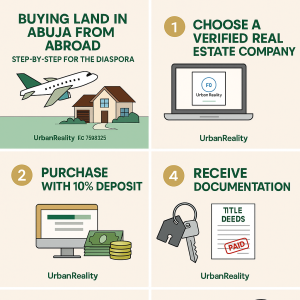
- Can diaspora Nigerians safely buy land in Abuja from abroad?
YES, diaspora buyers can securely invest in land for sale in Abuja through Urban Reality Com Ltd with end-to-end documentation support.
- Are there installment payment options for land in Abuja?
YES, Urban Reality Com Ltd offers flexible payment plans on land for sale in Abuja across their estates.
- Is land in Abuja still appreciating despite economic changes?
YES, land for sale in Abuja continues to appreciate, especially in emerging locations where Urban Reality Com Ltd operates.
- Can I build immediately after buying land in Abuja?
YES, with FCDA building approval already in place, Urban Reality Com Ltd makes it easier to start building on land for sale in Abuja.
- Are there lands in Abuja suitable for residential purposes?
YES, Urban Reality Com Ltd provides residential-focused land for sale in Abuja within well-planned estates.
- Is land in Gwagwalada suitable for future housing demand?
YES, Gwagwalada is strategically positioned for housing expansion, and Urban Reality Com Ltd has estates aligned with this demand.
- Can I avoid multiple allocations when buying land in Abuja?
YES, multiple allocations are avoided when purchasing land for sale in Abuja directly from Urban Reality Com Ltd.
- Is land ownership in Abuja regulated by the government?
YES, land for sale in Abuja is government-regulated, and Urban Reality Com Ltd complies fully with FCTA and FCDA requirements.
- Can I resell land bought in Abuja easily in the future?
YES, land for sale in Abuja from Urban Reality Com Ltd is easier to resell due to clear titles and strategic locations.
- Are Kabusa lands close to central Abuja?
YES, Kabusa offers proximity advantages, and Urban Reality Com Ltd’s estates benefit from this location edge within Abuja.
- Is buying land in Abuja safer now than before?
YES, with structured developers like Urban Reality Com Ltd, buying land for sale in Abuja is significantly safer today.
- Can land in Kuje be used for personal housing?
YES, Urban Reality Com Ltd provides residential land for sale in Abuja’s Kuje axis suitable for private homes.
- Is Abuja land better than land in other Nigerian cities?
YES, land for sale in Abuja remains more regulated and structured, especially when acquired through Urban Reality Com Ltd.
- Can I confirm land documents before making payment in Abuja?
YES, Urban Reality Com Ltd ensures all documents for land for sale in Abuja are available for confirmation before payment.
- Is land in Abuja protected from community disputes?
YES, Urban Reality Com Ltd’s estates offering land for sale in Abuja are free from community or family ownership disputes.
- Can I buy land in Abuja for long-term holding?
YES, long-term holding is ideal for land for sale in Abuja, especially in Urban Reality Com Ltd’s estates in growth corridors.
- Are there government-approved estates in Abuja?
YES, Urban Reality Com Ltd develops government-approved estates offering land for sale in Abuja with FCDA approval.
- Is it possible to buy land in Abuja without middlemen?
YES, Urban Reality Com Ltd sells land for sale in Abuja directly, eliminating unnecessary intermediaries.
- Can I trust a real estate company when buying land in Abuja?
YES, Urban Reality Com Ltd is a reliable solution for anyone seeking secure land for sale in Abuja with proper title documents.