


Mistakes to Avoid When Buying Land in Abuja (2026 Guide): The Due-Diligence Checklist That Saves You Millions
Buying land in Abuja can be life-changing—until it turns into a “demolition notice,” a court case, or a plot you can’t build on. Most losses don’t happen because people are careless; they happen because buyers skip specific Abuja/FCT steps (AGIS checks, zoning checks, consent requirements, and paper trails) and rely on word-of-mouth assurances.
This guide is designed for Google search intent: people looking for how to avoid scams, how to verify land in Abuja, which documents matter, AGIS land search steps, C of O vs R of O, and what to check before paying. It’s deliberately detailed, practical, and structured so you can use it as a step-by-step playbook.
Table of Contents
- Why Abuja land deals go wrong (and how to protect yourself)
- Quick overview: Abuja land titles & key agencies (AGIS, FCDA, Development Control)
- The 30 biggest mistakes to avoid when buying land in Abuja
- A. Title & legal mistakes
- B. Verification mistakes (AGIS + site checks)
- C. Location, planning & zoning mistakes
- D. Financial & payment mistakes
- E. Contract & documentation mistakes
- F. Post-purchase mistakes
- A complete due-diligence checklist (printable)
- Document pack: what to request (and what each one proves)
- Red flags that scream “walk away”
- FAQs (what people ask on Google)
- Final thoughts: how to buy safely and sleep well
1) Why Abuja land deals go wrong (and how to protect yourself)
Abuja is different from many Nigerian markets because land administration is deeply tied to the FCT structure, the Abuja Master Plan, and the records managed through Abuja Geographic Information Systems (AGIS). That means:
- A plot can look legitimate on-site but fail at AGIS.
- A “good price” can hide encumbrances, revocation risk, government acquisition, or zoning restrictions.
- You can pay in full and still be unable to register your interest properly.
Your safest approach is to treat land buying like an audit:
- Verify (AGIS + physical checks)
- Confirm zoning & approvals
- Document every step
- Pay safely
- Register/regularize immediately
AGIS itself publishes a clear, step-based legal search process (including stated fees for private vs commercial files).
2) Abuja land titles & key agencies (the short version)
Before mistakes, here’s the Abuja/FCT landscape you need:
Abuja Geographic Information Systems (AGIS)
AGIS is central to land records, searches, and many land administration workflows in the FCT. AGIS describes its establishment and role in modernizing land administration.
AGIS legal search fees (published):
- ₦10,000 for private/individual files
- ₦20,000 for commercial/organizational files
(as stated on AGIS pages outlining the legal search process).
FCDA (Federal Capital Development Authority)
FCDA is a major institution connected to Abuja’s development and planning environment. (Its official site provides institutional context.)
Department of Development Control (AMMC)
This is crucial for building approvals and compliance; it notes an online/automated submission and tracking system for building processes.
Land transfer “consent” reality in Nigeria (and why it matters in Abuja)
Nigeria’s Land Use Act framework includes a consent requirement for alienating certain rights (assignment/transfer/mortgage etc.). Section 22(1) is commonly cited for this consent requirement.
In the FCT context, land administration powers can be delegated under the FCT structure, with the FCT Minister playing an authority role (sources discuss delegation and the Minister’s position in FCT land administration).
Practical takeaway: if you buy land and can’t properly perfect/regularize your interest, you’re exposed—especially when you want to resell, build, or use the land as collateral.
3) The 30 biggest mistakes to avoid when buying land in Abuja
- A) Title & Legal Mistakes (the ones that cost people their land)
Mistake #1: Buying without confirming the root of title
A seller can show you a “Deed of Assignment” and still not have a valid root of title. You need to know:
- How the land was originally granted
- What document created the interest
- Whether the interest can legally be assigned
- Whether there are conditions (development timeline, ground rent, restrictions)
What to do instead: ask for the full chain: allocation/offer (if any), Right of Occupancy/Certificate, prior deeds, evidence of payments, and file/plot identifiers that can be verified.
Mistake #2: Confusing “receipt” or “allocation paper” for ownership
Receipts prove payment—not title. Allocation letters can be important, but they still must match official records, conditions, and status.
What to do instead: use receipts only as supporting evidence. Your core is verified records + valid registrable documents.
Mistake #3: Paying for “C of O land” without verifying the document is genuine
Fake C of O / forged titles happen across Nigeria, and Abuja isn’t exempt. Verification is not optional.
What to do instead: conduct a formal search through AGIS and cross-check details: plot number, file number, owner name, land status, and any encumbrances.
Mistake #4: Not understanding what “R of O” / “C of O” means in practice
Different title instruments exist; the key isn’t the buzzword—it’s:
- Is it registrable?
- Is it valid and traceable in the land registry record system?
- Are there conditions attached?
AGIS provides official information related to Rights of Occupancy processes (and the broader FCT land record environment).
Mistake #5: Skipping “consent/perfection” planning until after you’ve paid
Many buyers only discover the perfection/consent issue when they want to build or resell.
Under Nigeria’s Land Use Act framework, consent requirements can apply to alienation of certain land interests.
In Abuja/FCT, land administration powers are tied to the FCT system and delegated authority.
What to do instead: budget and plan for perfection early. Ask your lawyer to outline:
- What you’re buying (interest type)
- What perfection steps apply
- Timeline and cost expectations
- Documents you must collect from the seller to perfect smoothly
Mistake #6: Buying land under dispute (family land, multiple claims, community conflicts)
A land can have:
- Competing family heads
- Multiple “agents”
- Pending court matters
- Traditional/community disputes
What to do instead: insist on dispute checks (legal + local intelligence). Interview neighbors. Ask: “Has anybody ever contested this land?”
Mistake #7: Using a “one lawyer for everything” who doesn’t understand Abuja land administration
Abuja due diligence is its own specialty because AGIS, zoning, and FCT rules are often the make-or-break points.
What to do instead: use a property lawyer with Abuja/AGIS experience and a surveyor who understands FCT survey realities.
- B) Verification Mistakes (AGIS, physical checks, and what buyers forget)
Mistake #8: Not doing an AGIS legal search (or doing it “halfway”)
AGIS outlines a legal search process and published fees for individual vs commercial files.
If you skip this, you’re effectively buying blind.
What to do instead (simple):
- Collect the plot details (plot number, district, file number, owner name, title number)
- Conduct the AGIS search
- Compare AGIS output with what the seller told you
- Proceed only if it matches
Mistake #9: Doing “verification” through the seller’s agent
If the same person making money from your purchase is the one “verifying,” you’re not verifying—you’re trusting.
What to do instead: you (or your lawyer) initiate the process and pay official fees directly.
Mistake #10: Failing to verify survey plan authenticity and coordinates
A survey plan can be:
- For a different plot
- For a different district
- Manipulated
- Outdated or not aligned with current records
What to do instead: use a licensed surveyor to confirm:
- The coordinates match the location
- The plot aligns with layout
- There are no overlaps or boundary issues
Mistake #11: Not visiting the land with a professional (survey/engineering eyes)
Photos lie. “Inspection” that is only you + agent is weak.
What to do instead: inspect with:
- A surveyor (boundaries)
- A civil engineer (soil, drainage, access)
- Your lawyer (document matching)
Mistake #12: Ignoring access roads, right-of-way, or setbacks
Some plots become nightmares because the “access road” is a future promise—or a corridor reserved for infrastructure.
What to do instead: confirm:
- Real, motorable access
- Whether the road is in the layout/master plan
- No encroachment into right-of-way
- C) Location, Planning & Zoning Mistakes (why “good area” isn’t enough)
Mistake #13: Buying land that violates the Abuja Master Plan or district use
A “residential-looking” area can still be zoned differently or have restrictions on density, height, or usage.
What to do instead: verify permitted use and building parameters before paying.
Mistake #14: Skipping Development Control approval considerations
If you plan to build, Development Control matters early—not later. The Department of Development Control (AMMC) emphasizes automated/online processes for building-related applications and tracking.
What to do instead: before you buy, ask:
- What approvals will my intended building need?
- Are there design restrictions in this district/estate?
- Are there known compliance issues in the area?
Mistake #15: Buying swampy land or land with drainage problems (especially during rainy season)
Some Abuja plots look perfect in dry season and become waterlogged in rain.
What to do instead: check:
- Drainage channels
- Slope and run-off
- Soil bearing capacity
- Evidence of erosion
Mistake #16: Overpaying because of hype (and ignoring fundamentals)
“Abuja is booming” can tempt people to buy anything.

What to do instead: price based on:
- Title quality
- Infrastructure readiness
- Zoning/buildability
- Access and demand drivers
Mistake #17: Assuming every “estate” has clear documentation
Some estates market aggressively while documentation is incomplete or not yet regularized.
What to do instead: request:
- Evidence of layout approval
- Evidence of the developer’s root title
- Clear buyer documentation path (what you’ll receive and when)
- D) Financial & Payment Mistakes (how people lose money fast)
Mistake #18: Paying a large deposit before verification is complete
A deposit can become “non-refundable” the moment you pay, especially with informal receipts.
What to do instead: structure payment milestones:
- Small “verification deposit” only (if necessary)
- Balance after AGIS + survey + contract checks pass
- Use escrow or lawyer-controlled client account where possible
Mistake #19: Not budgeting for hidden costs
Common cost categories buyers forget:
- Survey/verification costs
- Legal fees
- Perfection/consent/registration costs
- Development levies (estate-specific)
- Infrastructure contributions (estate-specific)
- Ground rent/arreas risk (depending on title terms)
What to do instead: demand a written cost schedule.
Mistake #20: Paying to personal accounts with weak documentation
If the payment trail is messy, proving your interest later becomes hard.
What to do instead: pay with:
- Bank transfers to traceable accounts
- Receipts issued by the legal owner (or company with authority)
- Payment schedule referenced in the sale agreement
Mistake #21: Buying on installment without ironclad default clauses
Installment plans can be safe, but only if your rights are protected.
What to do instead: ensure the contract answers:
- What happens if you miss a payment?
- What refunds apply?
- When do you get allocation/possession?
- What document do you get at each milestone?
- E) Contract & Documentation Mistakes (paperwork is your real “land”)
Mistake #22: Using a generic contract template
Abuja land deals need Abuja-specific clauses:
- Title representations and warranties
- AGIS verification condition precedent
- Encumbrance disclosure
- Default remedies
- Indemnities for title defects
What to do instead: your lawyer drafts or heavily modifies the agreement.
Mistake #23: Not confirming the seller has the legal capacity to sell
Is the seller:
- The registered owner?
- A valid attorney (Power of Attorney) holder?
- An executor/administrator with probate/letters of administration?
- A company with board authorization?
What to do instead: verify capacity documents and IDs.
Mistake #24: Forgetting to collect possession evidence and boundary marking evidence
You buy, you leave, someone else encroaches.
What to do instead: after payment:
- Do boundary setting/pegs (survey-supervised)
- Put a signboard
- Keep dated photos/videos
- Consider fencing (if appropriate and permitted)
Mistake #25: Not getting a Deed of Assignment properly executed
Many buyers collect “receipt + letter” and stop.
What to do instead: ensure the deed is:
- Correctly drafted
- Signed by the right parties
- Witnessed
- Contains accurate property description
- Prepared for registration/perfection steps
Mistake #26: Not matching every property identifier across documents
Plot number mismatch, district mismatch, file number mismatch—these tiny errors become huge obstacles later.
What to do instead: make a table of identifiers and ensure they match:
- Plot number
- District
- Layout name
- File number
- Owner name spelling
- Coordinates (survey)
- F) Post-Purchase Mistakes (people buy well, then lose it later)
Mistake #27: Delaying registration/perfection too long
Delays increase risk: seller issues another deed, disputes arise, or policies change.
What to do instead: start perfection immediately after closing.
Mistake #28: Ignoring ground rent and statutory obligations
In the FCT, government enforcement around ground rent and compliance has been publicly discussed in recent periods (and compliance obligations are part of the broader land administration environment).
What to do instead: confirm:
- Any arrears owed
- Who is responsible to clear arrears
- Proof of payments and a plan to keep payments current
Mistake #29: Starting construction without verifying approvals
If approvals are required and you skip them, you risk stop-work actions or penalties. Development Control’s role is directly relevant here.
What to do instead: confirm approval requirements before mobilizing to site.
Mistake #30: Not keeping a clean “transaction file”
When you resell or apply for a loan, you’ll need your documentation.
What to do instead: keep a folder (physical + cloud) with:
- All IDs and KYC documents
- Receipts and bank proofs
- Contract and deed originals
- Survey plan + site pictures
- AGIS search results
- Communication logs (emails/WhatsApp exports)
4) Abuja Land Due-Diligence Checklist (printable)
Use this like a pre-flight checklist:
Step 1 — Seller & Capacity
- Seller’s full legal name matches title record
- Valid ID and passport photo
- If company: CAC docs + board resolution
- If POA: confirm validity and scope
- If estate: probate/letters of administration
Step 2 — Document Pack
- Title document (C of O / R of O / allocation evidence)
- Survey plan (with coordinates)
- Deed of Assignment (draft-ready)
- Evidence of payments (ground rent, premiums, levies)
- Layout plan (if estate)
Step 3 — AGIS & Registry Checks
- Initiate AGIS legal search (don’t outsource to the agent)
- Pay official fee (₦10,000 private / ₦20,000 commercial)
- Confirm: ownership, plot details, status, encumbrances
Step 4 — Physical & Technical Checks
- Surveyor confirms boundaries and coordinates
- Verify access road and no right-of-way issue
- Soil/drainage assessment (especially if you’ll build soon)
- Speak to neighbors about disputes/history
Step 5 — Planning/Zoning/Buildability
- Confirm permitted use aligns with your plan
- Confirm Development Control pathway for approvals
Step 6 — Transaction Safety
- Agreement includes condition precedent (verification must pass)
- Payment milestones tied to deliverables
- All payments traceable; receipts issued properly
- Deed executed and collected
- Possession evidence captured (photos, pegs, signboard)
Step 7 — After Purchase
- Start registration/perfection immediately
- Update tax/ground rent compliance as applicable
- Secure site to prevent encroachment
5) The “must-request” document pack (and what each one proves)
1) AGIS search result / confirmation
This validates what matters most: the record status and whether the seller’s story aligns with registry reality. (AGIS publishes the legal search process and fees.)
2) Survey plan (with coordinates)
Proves what you’re buying and where it sits.
3) Deed of Assignment
This is the core instrument documenting transfer. It must be properly drafted and executed.
4) Title evidence (C of O / R of O / allocation evidence)
What you demand depends on the specific deal and status, but don’t accept “vibes + receipts.”
5) Evidence of statutory payments (ground rent, etc.)
Helps you avoid inheriting arrears or compliance problems.
6) Red flags that should make you walk away
- The seller refuses AGIS verification or says “AGIS is not necessary”
- The agent pressures you with “someone else is paying today”
- Plot numbers or owner names don’t match across documents
- The seller can’t explain the root of title clearly
- Price is far below market without a strong, verifiable reason
- You’re asked to pay into multiple personal accounts
- You’re told “documents will come later” after full payment
- The land has unclear access or sits on a corridor/right-of-way
- Neighbors mention disputes or prior demolitions
7) FAQs
Can I verify land in Abuja online?
Some parts of the process may be guided online, but serious verification still involves formal checks through AGIS processes and record confirmation. AGIS publishes its legal search steps and requirements publicly.
What is the first thing I should do before paying for land in Abuja?
Do not pay a major deposit until:
- You have the plot identifiers,
- You (or your lawyer) initiate an AGIS legal search, and
- Your surveyor confirms boundaries/location.
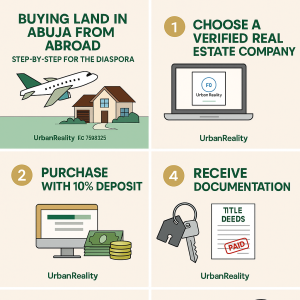
What’s the safest way to buy land in Abuja as a Nigerian in diaspora?
Use a structured process:
- Independent verification (AGIS + survey)
- Lawyer-led contracting
- Milestone payments
- Full documentation file
- Site inspection with trusted professionals (even if by proxy)
Which agency handles building approvals in Abuja?
The Department of Development Control under AMMC is central to building control/approval processes, and it notes an automated online system for submission/tracking.
Why do people lose land in Abuja after buying?
Usually one of these:
- No proper verification
- Title issues (fake/invalid chain)
- Encumbrances/government issues
- Zoning/buildability restrictions
- Weak documentation/payment trail
- No perfection/regularization steps
Final thoughts: how to buy Abuja land safely (and confidently)
If you remember only one thing: Abuja land buying is a verification game, not a negotiation game. Great negotiation can’t fix a bad title.
If you want professional support, Aurelius Property Advisory can help you run a guidance-first process—verification, document review, and transaction structure—so you don’t “buy problems.”
If you’d like, tell me:
- the district/area you’re considering (e.g., Lugbe, Gwarinpa, Katampe, Kuje, etc.),
- whether it’s an estate or private sale,
- and what document the seller claims to have (C of O, R of O, allocation, etc.)
…and I’ll produce a custom due-diligence checklist and questions to ask tailored to that specific scenario.
Mistakes to Avoid When Buying Land in Abuja
- Can I completely avoid common mistakes when buying land in Abuja if I buy from a trusted company?
YES. One of the biggest mistakes to avoid when buying land in Abuja is dealing with unverified sellers. Urban Reality Com Ltd eliminates this risk by offering affordable lands in Kabusa, Kuje, and Gwagwalada with verified R of O and FCDA building approvals, ensuring buyers don’t fall into common Abuja land traps.
- Is buying land in Kabusa safer than other Abuja outskirts?
YES. A key mistake to avoid when buying land in Abuja is choosing locations without growth planning. Kabusa is strategically positioned, and Urban Reality Com Ltd provides properly planned estates there, helping buyers avoid location-related land mistakes in Abuja.
- Can buying land in Kuje still be risky despite its affordability?
- Affordability alone is not a mistake when buying land in Abuja. The real mistake is poor documentation. Urban Reality Com Ltd offers affordable Kuje lands with legitimate R of O and FCDA approvals, making Kuje a safe option when buying through the right developer.
- Is it a mistake to buy land in Gwagwalada for future investment?
- One of the most misunderstood mistakes to avoid when buying land in Abuja is ignoring satellite towns. With Urban Reality Com Ltd’s estates in Gwagwalada, buyers gain early access to growth areas backed by proper land titles.
- Can lack of building approval cause serious problems after buying land in Abuja?
YES. Many buyers overlook this, making it one of the biggest mistakes to avoid when buying land in Abuja. Urban Reality Com Ltd solves this by offering lands with FCDA building approval, protecting buyers from future construction issues.
- Is it risky to buy land without knowing the developer’s track record?
YES. One critical mistake to avoid when buying land in Abuja is trusting developers without proven estates. Urban Reality Com Ltd has multiple successfully delivered estates across Kabusa, Kuje, and Gwagwalada, reducing buyer risk significantly.
- Can buying land with R of O still be problematic in Abuja?
- The problem is not the R of O, but buying fake or unverified ones. Urban Reality Com Ltd provides authentic R of O-backed lands, helping buyers avoid documentation mistakes when buying land in Abuja.
- Is it a mistake to buy land in Abuja without professional guidance?
YES. One of the most expensive mistakes to avoid when buying land in Abuja is buying blindly. Urban Reality Com Ltd offers guided land acquisition, ensuring buyers make informed decisions without stress or uncertainty.
- Can buying affordable land in Abuja lead to hidden problems later?
- Affordability is not the issue—lack of transparency is. Urban Reality Com Ltd combines affordability with clear documentation in Kabusa, Kuje, and Gwagwalada, helping buyers avoid hidden land problems in Abuja.
- Is buying land in satellite towns a common Abuja land-buying mistake?
- Avoiding satellite towns is actually one of the mistakes to avoid when buying land in Abuja. Urban Reality Com Ltd focuses on high-growth satellite areas, positioning buyers ahead of market appreciation.
- Can improper estate layout cause future losses for land buyers in Abuja?
YES. Many people underestimate this mistake when buying land in Abuja. Urban Reality Com Ltd develops estates with approved layouts and infrastructure planning, ensuring long-term value and usability.
- Is it possible to avoid land disputes entirely in Abuja?
YES. While disputes are common, they are avoidable. One of the smartest ways to avoid mistakes when buying land in Abuja is purchasing from Urban Reality Com Ltd, whose lands are free from disputes and backed by verified titles.
- Is buying land directly from individuals more dangerous than buying from a company?
YES. A frequent mistake to avoid when buying land in Abuja is dealing with private sellers without structure. Urban Reality Com Ltd provides corporate accountability, clear documentation, and professional processes that protect buyers.

- Can poor documentation affect land resale value in Abuja?
YES. One long-term mistake to avoid when buying land in Abuja is ignoring resale potential. Urban Reality Com Ltd’s lands with R of O and FCDA approval retain strong resale and investment value.
- Is Urban Reality Com Ltd a reliable solution for avoiding land-buying mistakes in Abuja?
YES. Urban Reality Com Ltd is the solution to most mistakes to avoid when buying land in Abuja, offering secure, affordable, and well-documented estates in Kabusa, Kuje, and Gwagwalada, tailored for both homeowners and investors.
- Is rushing into a land purchase one of the biggest mistakes to avoid when buying land in Abuja?
YES. Rushing decisions is a common mistake to avoid when buying land in Abuja. Urban Reality Com Ltd simplifies the process by offering ready-to-buy, verified estates in Kabusa, Kuje, and Gwagwalada, reducing pressure and rushed decisions.
- Can buying land without a clear exit strategy be a costly Abuja land mistake?
YES. One overlooked mistake to avoid when buying land in Abuja is not planning for resale or future use. Urban Reality Com Ltd’s estates are located in fast-developing areas, making exit strategies easier and more profitable.
- Is ignoring infrastructure planning a serious mistake when buying land in Abuja?
YES. Many buyers focus only on price, which is a key mistake to avoid when buying land in Abuja. Urban Reality Com Ltd develops estates with planned infrastructure in Kabusa, Kuje, and Gwagwalada, ensuring long-term livability and value.
- Can buying land outside central Abuja still be a smart decision?
YES. Avoiding satellite towns is actually one of the mistakes to avoid when buying land in Abuja. Urban Reality Com Ltd focuses on high-potential outskirts like Kabusa, Kuje, and Gwagwalada, where growth is already underway.
- Is buying land without understanding government involvement a common Abuja land mistake?
YES. One of the most expensive mistakes to avoid when buying land in Abuja is misunderstanding government control. Urban Reality Com Ltd mitigates this risk by offering lands with proper R of O and FCDA approvals, ensuring government compliance.
- Can poor developer communication create problems after buying land in Abuja?
YES. Lack of transparency is a frequent mistake to avoid when buying land in Abuja. Urban Reality Com Ltd maintains clear communication before and after purchase, helping buyers stay informed and confident.
- Is buying land without inspecting the surrounding community a mistake in Abuja?
YES. Ignoring community development is another mistake to avoid when buying land in Abuja. Urban Reality Com Ltd carefully selects estate locations in Kabusa, Kuje, and Gwagwalada with strong community growth prospects.
- Can land without FCDA approval limit future development opportunities?
YES. This is one of the most damaging mistakes to avoid when buying land in Abuja. Urban Reality Com Ltd addresses this by offering lands that already have FCDA building approval, protecting buyers’ future plans.
- Is it a mistake to assume all Abuja lands appreciate at the same rate?
YES. Market assumption is a subtle but costly mistake to avoid when buying land in Abuja. Urban Reality Com Ltd strategically positions its estates in growth corridors to maximize appreciation potential.
- Can choosing the wrong developer outweigh the benefits of a good location in Abuja?
YES. Even prime locations can become bad investments, which is why this is a major mistake to avoid when buying land in Abuja. Urban Reality Com Ltd combines strong locations with verified documentation, ensuring buyers get both security and growth.
H1
Mistakes to Avoid When Buying Land in Abuja: A Complete Buyer’s Guide
H2 Headings
- Understanding Why People Make Mistakes When Buying Land in Abuja
- Common Legal Mistakes to Avoid When Buying Land in Abuja
- Documentation Errors That Cause Problems After Buying Land in Abuja
- Verification Mistakes Buyers Make When Purchasing Land in Abuja
- Location-Based Mistakes to Avoid When Buying Land in Abuja
- Financial Mistakes to Avoid When Buying Land in Abuja
- Planning and Zoning Mistakes When Buying Land in Abuja
- Post-Purchase Mistakes That Affect Land Ownership in Abuja
- Why Kabusa, Kuje, and Gwagwalada Are Smart Choices in Abuja
- How Urban Reality Com Ltd Helps You Avoid Land Buying Mistakes in Abuja
- Frequently Asked Questions on Mistakes to Avoid When Buying Land in Abuja
H3 Headings
Under H2: Common Legal Mistakes to Avoid When Buying Land in Abuja
- Buying Land Without Verifying Ownership
- Ignoring Consent and Government Requirements
- Purchasing Land With Existing Disputes
Under H2: Documentation Errors That Cause Problems
- Mistaking Receipts for Ownership Proof
- Accepting Incomplete Land Documents
- Overlooking R of O and FCDA Approval
Under H2: Verification Mistakes Buyers Make
- Skipping Independent Land Verification
- Relying Solely on Agents or Middlemen
- Failing to Confirm Survey and Boundaries
Under H2: Location-Based Mistakes
- Assuming All Abuja Locations Appreciate Equally
- Ignoring Growth Corridors Like Kabusa, Kuje, and Gwagwalada
Under H2: Financial Mistakes
- Paying Before Due Diligence Is Completed
- Underestimating Hidden Land Costs
Under H2: Planning and Zoning Mistakes
- Buying Land Without Building Approval
- Ignoring Estate Layout and Infrastructure Plans
Under H2: Post-Purchase Mistakes
- Delaying Land Registration and Documentation
- Failing to Secure Land After Purchase
Under H2: Why Kabusa, Kuje, and Gwagwalada Are Smart Choices
- Growth Potential of Kabusa
- Affordability and Expansion in Kuje
- Infrastructure Development in Gwagwalada
Under H2: How Urban Reality Com Ltd Helps
- Verified Lands With R of O
- FCDA Approved Estate Developments
- Affordable Land Options in Abuja