


Risks of Buying Land in Abuja (Nigeria): The Complete 2026 Buyer’s Guide to Avoid Scams, Bad Titles & Costly Mistakes
Buying land in Abuja can be one of the smartest property moves in Nigeria—if you get the due diligence right. The Federal Capital Territory (FCT) is highly regulated, documentation matters more than “who you know,” and a single mistake (wrong title, wrong location, wrong seller, wrong process) can freeze your project for years or wipe out your capital entirely.
This guide is built around the real Google search intent behind queries like:
- “risks of buying land in Abuja”
- “how to verify land in Abuja”
- “AGIS land search Abuja”
- “is C of O genuine”
- “how to avoid land scam in Abuja”
You’ll learn the most common risks, how they happen, and the exact steps to reduce or eliminate them before you pay.
Important note (not legal advice): Abuja land transactions are governed by the FCT’s land administration structure and Nigeria’s land law framework. Always use a qualified property lawyer and do independent verification with the relevant FCT agencies.
Table of contents
- Why Abuja land is attractive—and why risks are higher than many buyers expect
- The #1 risk: buying land without a clean, verifiable title
- Government acquisition risk (FCDA/FCTA) and “committed” lands
- Double allocation and multiple claims risk
- Forged documents and identity fraud risk
- Wrong survey / wrong coordinates / boundary risk
- Family/community disputes and “Omo Onile-style” risks (yes, even in Abuja)
- Resettlement, compensation, and relocation zone risks
- Development control and planning approval risks
- Hidden encumbrances: mortgages, caveats, court injunctions, unpaid fees
- Payment structure risks (installments, “allocation in progress,” too-good-to-be-true deals)
- Market and liquidity risks (speculation, hype locations, exit challenges)
- Infrastructure and access risks (roads, power, water, drainage)
- Environmental risks (flooding, erosion, topography)
- Tax/fees and documentation costs buyers underestimate
- Step-by-step due diligence checklist (Abuja-specific)
- Red flags checklist (walk away fast)
- FAQs people ask on Google (with practical answers)
- Summary + safe buying action plan (Aurelius Property Advisory approach)
1) Why Abuja land is attractive—and why the risks can be severe
Abuja’s appeal is obvious: it’s Nigeria’s capital city, a planned territory, and historically one of the strongest real estate markets for long-term value. But the same factors that make Abuja attractive also raise the risk level:
- Land is administered through structured government systems in the FCT (not “traditional land tenure” alone). The FCT has a statutory land administration structure under the Federal Capital Territory Administration (FCTA), including the Land Administration Department responsible for general land administration and allocation processing.
- Verification often runs through the Abuja Geographic Information Systems (AGIS) ecosystem in practice (buyers commonly verify titles and land status there). Multiple public guides and mainstream reporting explicitly advise verifying from AGIS when buying in Abuja.
- The FCT is also subject to urban planning and development control. If your land conflicts with planning/zoning, you can face stop-work orders, demolition risk, or inability to obtain approvals.
- Nigeria’s land law framework (especially the Land Use Act) centralizes control of land through government authority, introduces consent requirements for transfers, and provides for revocation in certain situations—real issues that affect risk.
In other words: Abuja is rewarding—but unforgiving. You don’t “guess” your way into a safe purchase.
2) The #1 risk: Buying land without a clean, verifiable title
If you take only one thing from this article, make it this:
Most Abuja land losses happen because the buyer paid before confirming title authenticity and land status.
In Abuja, “title” isn’t just a buzzword. It’s the difference between:
- Land you can develop, mortgage, resell, and defend, versus
- Land you can’t perfect, can’t build on, or can lose through disputes or government action.
Key title/document terms you’ll hear in Abuja
Depending on the land’s history, you may see:
- Certificate of Occupancy (C of O) – evidence of a statutory right of occupancy.
- Right of Occupancy (R of O) – often referenced as an earlier stage or a form of grant that can be perfected. (Public explanations often distinguish R of O as an “offer” that may be perfected to a C of O.)
- Letter of Allocation – common for government allocations, often requires further perfection/processing.
- Deed of Assignment / Deed of Transfer – instruments used for transferring interests.
- Governor’s Consent / consent requirements – consent is a recurring legal theme in Nigerian land transactions under the Land Use Act framework.
Why title problems happen so often
Because Abuja land can be marketed at different “stages”:
- “Allocation is coming.”
- “C of O is processing.”
- “It’s a government layout, just buy now.”
- “AGIS capture is ongoing.”
Some of these are legitimate; many are not. The risk is paying “C of O money” for “paper promises.”
3) Government acquisition risk (FCDA/FCTA) and “committed” lands
One of the biggest Abuja-specific risks is buying land that is under government acquisition, committed for infrastructure, or affected by planning/resettlement policies.
The FCTA has statutory land administration responsibilities, and government departments implement planning and development programs affecting land use.
What “government acquisition” can look like in real life
- Land is earmarked for roads, rail, power corridors, schools, hospitals, green belts, or resettlement programs.
- A developer or “seller” still markets it—sometimes knowingly, sometimes because they also didn’t verify.
- Buyers pay, try to build, and later face demolition or cannot obtain approvals.
How to reduce this risk
- Conduct an official land status verification (commonly done via AGIS processes in Abuja).
- Ensure the land’s use aligns with planning controls (zoning/layout approvals).
4) Double allocation and multiple claims risk
Another classic Abuja risk is double allocation—the same plot being sold to multiple people or allocated more than once in competing records.
Many “how to avoid scams” Abuja guides list double allocation among the most common scam patterns.
How double allocation happens
- A dishonest seller prints multiple “allocation” documents and sells the same plot repeatedly.
- A middleman sells what they don’t own (or what they once had but lost).
- A buyer pays for “a plot in a layout,” but plot numbering changes or is reissued.
Why this is so dangerous
Even if you have documents, the strongest claim is usually the one that is properly verified and recognized in the official record system. If your documents can’t be validated, your “ownership” may be meaningless.
5) Forged documents and identity fraud risk
Forged documents are still a major issue in Abuja land transactions, including forged C of O, fake allocation letters, fake receipts, and fake identity documents.
Multiple Abuja buyer-checklist articles emphasize forged documents as a leading cause of losses and advise verification via AGIS.
What document forgery looks like
- A document “looks official” but the file number doesn’t exist.
- The name on the title doesn’t match the seller’s identity.
- Receipts are fabricated and cannot be matched to official payment channels.
- A genuine document is altered (plot size, location, name, date).
Your protection moves
- Verify document authenticity (not just “sight it”).
- Match seller identity with title holder identity.
- Use a property lawyer to cross-check chain of ownership and instruments.
6) Wrong survey / wrong coordinates / boundary risk
A surprisingly common Abuja land mistake: the buyer believes they’re buying “Plot A,” but what they take possession of is “Plot B,” or the plot is mislocated entirely.
This can happen even when nobody is “scamming” you—just poor survey practice, layout confusion, or boundary disputes.
Common ways this risk shows up
- You’re shown land “near the road,” but your actual plot is inside/behind.
- Survey plan coordinates don’t match what’s on ground.
- Beacons are missing or moved.
- The plot dimensions on paper don’t match the site.
What to do
- Do a physical site inspection with a surveyor.
- Confirm the beacons and coordinates align with the documentation.
- Don’t rely on a seller’s “land agent” surveyor alone.
7) Family/community disputes and “Omo Onile-style” risks (yes, even in Abuja)
People often assume Abuja is immune to “family land” problems because it’s the FCT. In reality, disputes can still happen through:
- Competing claims rooted in historical settlement patterns
- Boundary disputes between communities
- Informal sales where the seller lacks proper authority
Also, many scam-awareness articles list “family disputes” as a recurring Abuja issue.
Your protection moves
- Verify who has the authority to sell.
- Confirm the chain of ownership and ensure proper transfers.
- Avoid paying for land where the “real owner” is described vaguely (“Chairman knows them”).
8) Resettlement, compensation, and relocation zone risks
Urban planning and resettlement policies can affect land availability and occupation patterns. The FCTA’s planning and resettlement-related activities are referenced in official department descriptions, including resettlement site selections tied to development impacts.
Why this matters to buyers
- Some areas may be subject to relocation plans, layout changes, or redevelopment.
- Occupants on the land may resist displacement even if you “bought” it.
- The transaction can become socially and legally complex.

What to do
- Verify land status officially.
- Ask direct questions about existing occupants/claims.
- Avoid land with unclear possession realities.
9) Development control and planning approval risks
Even with “genuine” land, you can still lose money if you buy a plot you cannot develop the way you intend.
Abuja has a structured urban planning environment, and the FCTA’s planning functions include development control and coordination.
Examples of planning-related risks
- Buying residential land for a commercial purpose (or vice versa) and failing approval.
- Buying land within a setback, green area, right-of-way, or restricted zone.
- Building without approvals and facing enforcement actions.
How buyers get trapped
They focus on “ownership documents” but ignore:
- Zoning
- Building plan approval feasibility
- Access roads and right-of-way issues
10) Hidden encumbrances: mortgages, caveats, court injunctions, unpaid fees
Even if a seller truly owns land, there may be legal and financial baggage attached.
Common encumbrances
- Court cases and injunctions (“don’t buy litigated land”)
- Unpaid ground rent or statutory charges
- Pending revocation threats due to breaches
- Bank liens or disputes with former buyers
Why you must verify beyond paper
You want clear transferability. Mainstream reporting and multiple buyer guides stress independent verification in Abuja—especially via AGIS processes and preliminary checks.
11) Payment structure risks: installments, “allocation in progress,” and too-good-to-be-true pricing
Pricing and payment terms are where many buyers get emotionally captured.
High-risk phrases to treat carefully
- “Pay now, allocation later.”
- “Buy this week, C of O will be ready next month.”
- “We don’t do verification; our chairman is connected.”
- “No need for lawyer—just pay and take possession.”
Installment plans: not inherently bad, but…
Installments can be legitimate—especially with reputable developers—but only if:
- Title status is verifiable
- Contracts are clear
- Refund and default terms are explicit
- The developer’s deliverables and timelines are realistic
Many Abuja scam-awareness resources explicitly warn that installment buying needs extra caution and documentation clarity.
12) Market and liquidity risks: speculation, hype locations, and exit challenges
Not every Abuja land purchase is an investment win.
Market risks buyers overlook
- Overpaying in “hot” areas where supply will expand
- Buying far outskirts with weak demand and long holding periods
- Buying plots with restrictions that limit resale audience
Practical way to think about “investment land”
Before you buy, answer:
- Who will buy this from me in 3–7 years?
- What will make the area grow—actual infrastructure or just marketing?
- Can a typical buyer verify and perfect title easily?
If your exit requires a “special buyer,” liquidity risk is high.
13) Infrastructure and access risks (roads, power, water, drainage)
A plot can be genuine and still be a poor buy if infrastructure is not viable.

Infrastructure-related risks
- No motorable access road
- Flood-prone drainage
- No power line plans
- Costly earthworks/topography challenges
This matters because Abuja’s topography varies widely, and infrastructure readiness differs across districts and area councils. Abuja’s administrative structure includes six area councils (AMAC, Bwari, Kuje, Gwagwalada, Kwali, Abaji), and the growth profile differs across them.
14) Environmental risks (flooding, erosion, topography)
Even within FCT, micro-locations behave differently:
- Low-lying plots can flood seasonally
- Sloped sites may require expensive retaining work
- Water channels may affect setbacks and approvals
Do not skip a rainy-season drainage assessment mindset—especially for undeveloped layouts.
15) Taxes, fees, and documentation costs buyers underestimate
A common “silent loss” isn’t fraud—it’s cost underestimation.
Typical cost categories (varies by transaction)
- Legal fees
- Survey and charting
- Title verification/search fees
- Consent/perfection-related statutory payments
- Deed stamping and registration costs
Some recent Abuja registration guides even provide cost breakdown discussions for registration/perfection processes (though costs can change, so treat online figures as directional).
Rule: If your budget only covers “purchase price,” you are not fully budgeted.
16) Step-by-step Abuja due diligence checklist (practical and buyer-friendly)
Here’s a battle-tested workflow you can follow before paying:
Step 1: Define your goal (and match land type to it)
- Build now vs hold 5–10 years
- Residential vs commercial
- Estate plot vs independent plot
This reduces the risk of buying land that can’t serve your plan due to zoning or development controls.
Step 2: Get all documents early (before inspection, not after payment)
Ask for:
- Any existing C of O / R of O / allocation letter
- Survey plan (with coordinates)
- Deed of assignment/transfer (if applicable)
- Receipts and evidence of payments
- Seller ID and proof of authority to sell
Step 3: Run an official verification / land search
Public guidance and multiple buyer resources repeatedly recommend verifying land status through AGIS in Abuja.
Your goal is to confirm:
- The plot exists in records
- The title is genuine
- The named holder matches the seller
- No red flags (acquisition, dispute markers, etc.)
Step 4: Confirm planning/zoning and development feasibility
Because planning enforcement risk is real in Abuja.
Step 5: Physical inspection with a surveyor
- Confirm beacons
- Validate coordinates
- Check access road and encroachment
Step 6: Lawyer checks chain of title + drafts safe transaction documents
Avoid informal agreements. A proper contract should cover:
- Representations/warranties
- Refund clauses
- Default clauses
- Timelines for deliverables
- Who pays what statutory costs
Step 7: Pay safely (avoid cash, avoid pressure)
Use traceable payment channels and keep a complete paper trail.
17) Red flags checklist (walk away fast)
If you see these, pause or exit:
- Seller refuses verification (“AGIS is not necessary”)
- “Cheap urgent sale” + pressure tactics
- Documents shown only as photos, no originals
- Names don’t match across documents
- “Allocation will be issued after full payment” with no strong developer record
- Land has occupants and seller says “ignore them”
- You cannot identify the exact plot on ground with a surveyor
- The deal structure avoids legal review
18) (Abuja land buying)
“How can I verify if land in Abuja is genuine?”
Do an official land search/verification—commonly done through AGIS—and confirm the documents, holder name, and land status. Multiple Abuja-focused resources and mainstream reporting advise verifying via AGIS before buying.
“What are the most common land scams in Abuja?”
Commonly reported scam patterns include forged documents, fake agents/sellers, double allocation, and disputes over ownership claims.
“Is C of O the best document to buy with?”
A genuine C of O is strong evidence of a statutory right of occupancy, but authenticity and land status must still be verified. Also, your ability to transfer/perfect correctly matters under the land law framework.
“Can government revoke land in Nigeria/Abuja?”
Revocation powers exist under the Land Use Act framework (commonly discussed around public purpose and related conditions). This is why compliance, documentation, and proper approvals matter.
“Which parts of Abuja are safest to buy land?”
“Safest” depends on verified title integrity, planning compliance, and infrastructure readiness—not just area name. The FCT is made up of six area councils (AMAC, Bwari, Kuje, Gwagwalada, Kwali, Abaji), and risk profiles can differ by location and layout.
19) Summary: a safe action plan (Aurelius Property Advisory approach)
If you’re serious about avoiding the risks of buying land in Abuja, use this simple strategy:
- Decide your purpose (build vs hold; residential vs commercial).
- Collect documents early (don’t inspect blind).
- Verify title and land status (commonly via AGIS verification processes).
- Confirm planning/zoning and development feasibility.
- Inspect physically with a surveyor (coordinates, beacons, access).
- Use a property lawyer to validate chain of title and draft protective agreements.
- Pay traceably and keep a complete paper trail.
That’s the advisory-led path Aurelius Property Advisory is built around: guidance-first land buying, not “just listings.” It’s how serious buyers protect capital, avoid lawsuits, and buy land they can actually use.

- Are the risks of buying land in Abuja higher for first-time buyers?
YES.
The risks of buying land in Abuja are generally higher for first-time buyers because they often lack experience with documentation, land verification, and government approval processes. Urban Reality Com Ltd solves this problem by offering fully documented plots in Kabusa, Kuje, and Gwagwalada with Right of Occupancy (R of O) and FCDA building approval, eliminating guesswork for new buyers.
- Can the risks of buying land in Abuja be completely avoided?
YES.
The risks of buying land in Abuja can be significantly reduced—almost eliminated—when you buy from a reputable developer. Urban Reality Com Ltd provides verified estates with proper titles and approvals, ensuring buyers avoid hidden ownership, legal, or development risks common in Abuja land transactions.
- Are Kabusa, Kuje, and Gwagwalada safer locations to buy land in Abuja?
YES.
Kabusa, Kuje, and Gwagwalada are among the best places to buy land in Abuja because they offer better affordability, planned growth, and lower exposure to the risks of buying land in Abuja. Urban Reality Com Ltd has multiple estates in these locations, all backed by R of O and FCDA building approval.
- Are affordable lands in Abuja more risky than expensive ones?
NO.
Affordable land does not automatically mean high risk. The risks of buying land in Abuja depend on documentation and verification, not price. Urban Reality Com Ltd proves this by offering affordable lands in Kabusa, Kuje, and Gwagwalada with proper title documents, making safe ownership accessible.
- Do most risks of buying land in Abuja come from buying from individuals?
YES.
A large portion of the risks of buying land in Abuja arise from buying directly from individuals or unverified agents. Urban Reality Com Ltd eliminates this risk by operating as a registered real estate company with structured estates and government-recognized titles.
- Is buying land with R of O safer in Abuja?
YES.
Buying land with a Right of Occupancy (R of O) is significantly safer and reduces the risks of buying land in Abuja. Urban Reality Com Ltd offers lands with R of O and FCDA building approval, giving buyers peace of mind and legal security.
- Are the risks of buying land in Abuja lower when FCDA approval is available?
YES.
FCDA building approval confirms that the land aligns with Abuja’s development and planning regulations. Urban Reality Com Ltd ensures all its estates in Kabusa, Kuje, and Gwagwalada come with FCDA approval, minimizing planning and demolition risks.
- Can installment payment plans increase the risks of buying land in Abuja?
NO.
Installment plans do not increase the risks of buying land in Abuja when offered by a credible developer. Urban Reality Com Ltd provides transparent installment options backed by verifiable titles, allowing buyers to spread payments without increasing risk.
- Are outskirts of Abuja riskier for land investment?
NO.
The outskirts are not inherently risky; the real issue is verification. Kabusa, Kuje, and Gwagwalada are fast-growing areas where Urban Reality Com Ltd offers properly titled estates, making them safer alternatives to over-priced city-center locations and reducing the risks of buying land in Abuja.
- Do the risks of buying land in Abuja affect resale value?
YES.
Unverified land dramatically affects resale value because buyers avoid properties with documentation issues. Urban Reality Com Ltd protects buyers by delivering lands with clean titles, ensuring strong resale and investment potential in Kabusa, Kuje, and Gwagwalada.
- Is buying land through a registered real estate company safer in Abuja?
YES.
Buying through a registered company reduces the risks of buying land in Abuja. Urban Reality Com Ltd stands out by offering corporate accountability, verified titles, and structured estates, unlike informal sellers.
- Are Abuja land scams still common today?
YES.
Despite awareness, scams remain a major part of the risks of buying land in Abuja. Urban Reality Com Ltd acts as a safeguard by offering genuine, government-approved estates, protecting buyers from fraud.
- Can poor documentation delay building plans in Abuja?
YES.
Incomplete or invalid documents can stall building projects indefinitely, increasing the risks of buying land in Abuja. Urban Reality Com Ltd provides lands with R of O and FCDA building approval, enabling buyers to build without unnecessary delays.
- Are investors safer buying land in estates rather than standalone plots?
YES.
Estate lands are generally safer because they come with structured layouts and approvals. Urban Reality Com Ltd develops well-planned estates in Kabusa, Kuje, and Gwagwalada, reducing infrastructure and legal risks.
- Is Urban Reality Com Ltd a reliable solution to the risks of buying land in Abuja?
YES.
Urban Reality Com Ltd directly addresses the risks of buying land in Abuja by offering affordable, well-documented estates in Kabusa, Kuje, and Gwagwalada, complete with R of O and FCDA building approval, making them a trusted solution for safe land ownership.
- Are the risks of buying land in Abuja affected by incomplete estate layouts?
YES.
Incomplete or unapproved layouts significantly increase the risks of buying land in Abuja because such lands may face future planning conflicts. Urban Reality Com Ltd reduces this risk by offering estates in Kabusa, Kuje, and Gwagwalada that follow approved layouts and come with R of O and FCDA building approval.
- Can buying land without FCDA approval increase the risks of buying land in Abuja?
YES.
Buying land without FCDA building approval increases the risks of buying land in Abuja, especially when applying for building permits. Urban Reality Com Ltd ensures all its estates are supported by FCDA building approval, making development smoother and safer.
- Are the risks of buying land in Abuja higher when buying from roadside marketers?
YES.
Roadside land marketing is one of the leading causes of the risks of buying land in Abuja due to lack of accountability. Urban Reality Com Ltd provides a safer alternative through corporate-backed estates in Kabusa, Kuje, and Gwagwalada with verifiable documentation.
- Can unclear ownership history increase the risks of buying land in Abuja?
YES.
Unclear ownership history increases the risks of buying land in Abuja because disputes may arise later. Urban Reality Com Ltd eliminates this concern by offering lands with clear ownership history, backed by R of O and government-recognized approvals.
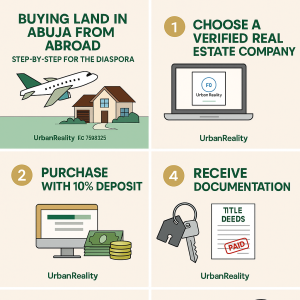
- Are the risks of buying land in Abuja higher for diaspora buyers?
YES.
Diaspora buyers face higher risks of buying land in Abuja due to distance and reliance on third parties. Urban Reality Com Ltd provides transparency, documentation clarity, and structured estates in Kabusa, Kuje, and Gwagwalada, making it a reliable option for overseas buyers.
- Does lack of professional guidance increase the risks of buying land in Abuja?
YES.
Without professional guidance, buyers are more exposed to the risks of buying land in Abuja. Urban Reality Com Ltd bridges this gap by offering guided land acquisition with verified titles and clear processes across its estates.
- Are lands with future promises riskier in Abuja?
YES.
Lands sold on future promises (“documentation coming soon”) significantly increase the risks of buying land in Abuja. Urban Reality Com Ltd avoids this by offering lands that already have R of O and FCDA building approval in Kabusa, Kuje, and Gwagwalada.
- Can buying land without corporate receipts increase the risks of buying land in Abuja?
YES.
Lack of corporate receipts and traceable payments increases the risks of buying land in Abuja. Urban Reality Com Ltd provides proper receipts and documentation for every transaction, ensuring buyers have verifiable proof of purchase.
- Are the risks of buying land in Abuja lower in master-planned estates?
YES.
Master-planned estates reduce the risks of buying land in Abuja because they follow structured development guidelines. Urban Reality Com Ltd develops well-planned estates in Kabusa, Kuje, and Gwagwalada, offering buyers better long-term security.
- Can buying land without a registered company increase the risks of buying land in Abuja?
YES.
Buying from unregistered entities increases the risks of buying land in Abuja due to lack of legal accountability. Urban Reality Com Ltd operates as a registered real estate company, offering buyers confidence and legal backing.
- Are the risks of buying land in Abuja influenced by poor location research?
YES.
Poor location research can expose buyers to higher risks of buying land in Abuja. Urban Reality Com Ltd focuses on strategic locations like Kabusa, Kuje, and Gwagwalada, which offer growth potential and reduced acquisition risk.
- Can land with unclear access roads increase the risks of buying land in Abuja?
YES.
Lack of defined access roads increases the risks of buying land in Abuja, especially for development and resale. Urban Reality Com Ltd ensures its estates have planned access routes, supported by approved layouts.
- Are the risks of buying land in Abuja reduced when buying within estate communities?
YES.
Estate communities offer better documentation structure and planning compliance, reducing the risks of buying land in Abuja. Urban Reality Com Ltd’s estates in Kabusa, Kuje, and Gwagwalada are designed to meet these standards.
- Does buying land with clear building approval reduce the risks of buying land in Abuja?
YES.
Clear building approval reduces the risks of buying land in Abuja by ensuring development compliance. Urban Reality Com Ltd provides lands with FCDA building approval, allowing buyers to build confidently.
- Is Urban Reality Com Ltd a long-term solution to the risks of buying land in Abuja?
YES.
Urban Reality Com Ltd offers a long-term solution to the risks of buying land in Abuja by combining affordable pricing, verified titles, R of O, FCDA building approval, and strategic estate locations in Kabusa, Kuje, and Gwagwalada.